Monday, 15 August 2022

2002

This time twenty years ago it was 2002. I was twenty-six and Rhona and I had been married for about 18 months, with our 5 year anniversary fast approaching. We were renting in Beckenham, and the kids were yet to come along. We did, howevere, have Dylan, our faithful 35kg+ Rotty x Staffy. I had made the decision to leave Murphy’s Lore that year and played my last gig with them in July. (I would, however, rejoin in 2005 before leaving again in 2014.) The main reason for leaving the band at that time was to try and prepare for having a family; the old ‘get a haircut and get a real job’ thang. I had an enrolled in a TAFE course, aiming to earn a diploma in IT. Rhona was working at call centre in Centrelink. I was attending TAFE, as well as playing solo and WGJS gigs. 

Seems like another lifetime ago. I guess it kinda is. Things were a bit different personally, but also just in the way the world is operating. Social media was not the behemoth it is now. I think ICQ was about as social as it got. Maybe chat rooms were around then too? Twitter and Facebook were still about six or seven years away. Maybe MySpace launched a coupla years later?

Anyway, I got to thinking of how when I was growing up in Perth and Albany in the 1980s, I was listening to a lot of sixties music, particularly The Beatles. There were a few popular hits on the charts that were sixties covers too, like Kylie's The Loco-motion and Twist & Shout by The Beatles became popular again due its inclusion in Ferris Bueller's Day Off.

So, I wanted to think about what was popular in music and movies twenty years ago. Is it enjoying a resurgence? Maybe it's a bit too early to get nostalgic at the 2000s, but I'm going to look at releases of 2002. 
No One Knows by Queens of the Stone Age would go on to top Triple J's Hottest 100 in January 2003, but I remained blissfully unaware of it until I heard that countdown. How out of touch was I? The No.1 song, and I had no idea what it was. I love the track now, of course. Heck, who doesn't? Got a gnarly red vinyl edish of it too. So, bear in mind that everything in these lists are twenty years old now!


MY TOP 10 ALBUMS of 2002:
1. Sea Change BECK
2. Yoshimi vs the Pink Robots THE FLAMING LIPS
3. Audioslave AUDIOSLAVE
4. A Rush of Blood to the Head COLDPLAY
5. Heathen DAVID BOWIE
6. Diorama SILVERCHAIR
7. Torch the Moon THE WHITLAMS
8. The Rising BRUCE SPRINGSTEEN
9. One By One FOO FIGHTERS
10. Tenacious D TENACIOUS D


MY TOP 10 MOVIES of 2002:
1. The Lord of the Rings: The Two Towers
2. Gangs of New York
3. Minority Report
4. Road to Perdition
5. The Pianist
6. City of God
7. Equilibrium
8. The Bourne Identity
9. Insomnia
10. Signs (hey, I liked it!)


MY TOP 5 SONGS of 2002:
1. Cochise AUDIOSLAVE
2. The Golden Age BECK
3. Without Me EMINEM
4. Keep Fishin' WEEZER
5. Comfort Me PACIFIER/SHIHAD


MY TOP 5 TV SHOWS of 2002:
1. 24 (season two)
2. The Sopranos (season 4)
3. Black Books (season 2)
4. The West Wing (season 4)
5. Kath & Kim (season 1) 


Sunday, 7 August 2022

Sunday Morning Albums

My buddy Kieran and I were waxing lyrical on the wonder of the Sunday morning album recently. He offered up the notion that that particular time of the week was optimal for enjoying good albums. But, what makes an album good for Sunday morning? 

I suppose it has to have several things going for it. Firstly, it has to be something that everyone present will enjoy, or at the very least, tolerate. If the music is familiar and well-loved it adds a cosy comfort to the morning atmosphere, but that's not necessary essential. It can be a gamble to try a maiden listen on a Sunday morning and a wobbly aural start to the day can be difficult to shift, if the mood isn't right. 

Ultimately, you want the musical equivalent of a loving hug. Or a welcoming sunrise. Something that seems to promise that today will be a good day. For a lot of people, Sunday morning is a special time, and to have a soundtrack worthy of inhabiting the family's ears is just good sense. It's a time to recharge and reflect on the week that was, while pondering the incoming one.

We always have a big breakfast on Sunday, or as we call it 'Special Breakfast'. Usually that means French toast and hashbrowns for the kids, bacon and eggs for me and Rhones. I tend to add in mushrooms and grilled tomato as well. It's one of the only times we all sit around the dining table together, and we always endeavour to keep it sacred. 

So, for the hour or so I spend in the kitchen preparing Special Breakfast, it's good to have some choice tunes going. I'll ruminate on this subject a bit more in the future, methinks, but for now, I will simply offer up some of my favourite albums to play on a Sunday morning.

*            *            *

Bryter Layter NICK DRAKE (1971)
A lovely, mellow record to throw on the turntable. It even has an instrumental track called Sunday that finishes it off. Drake's voice is quite soft-spoken, which results in a vocal delivery that doesn't intrude. It sits nicely in the background, but you can also sing along when you want to. Big hallmark of a Sunday morning album right there, I reckon. 

Tapestry CAROLE KING (1971)
Another good quality for a Sunday morning album to have is a solid tracklisting. This record is a prime example of the classic adage 'all killer, no filler'. Even when it starts off with the slightly funky I Feel The Earth Move, it's not intrusive. It's a hearty welcome to the morning in the guise of a piano riff. The ballads are certainly more enjoyable on a lazy Sunday, but the upbeat numbers don't make you feel like you should be getting up to clean house or anything.

Fleet Foxes FLEET FOXES (2008)
These guys are getting played quite a bit in our house at the moment. While our son Lachlan and I battle for sonic supremacy, there are a number of bands we both like to play. This is one of them, and this album is wonderful for a Sunday morning. Reverb-drenched vocals and folky music production together with hooks and lovely lyrics. When White Winter Hymnal kicks off, you can't help but hum or sing along. Their second album Helplessness Blues is also a corker. 

Spring and Fall PAUL KELLY (2012)
A fairly mellow affair, this album could also pass for a late night record. Following the loose concept of the start and end of a romantic relationship (the spring and fall, as it were), this has some of Kelly's best work on it. The promise of New Found Year, as the couple celebrate their love together sits well with the jaunty For The Ages. As the tide turns and the themes get darker, the musical production doesn't; it remains light and acoustic. None Of Your Business Now does have a menacing feel, but it doesn't grab you by the throat or anything. The album's closer, Little Aches and Pains, is one of my favourite PK songs ever. 


Feels Like Home NORAH JONES (2004) 
Norah's follow-up to Come Away With Me 
is a more enjoyable affair, in my humble opinion. There's a relaxed feeling that permeates the whole record, and it seems as though you're just listening to musicians jamming. Everything sounds effortless and easy, much like a Sunday morning should be. Her cover of Tom Waits' Long Way Home is a big highlight, as is What Am I To You?, which features Levon Helm on drums and Garth Hudson on keys.

Apple Venus XTC (1999)
XTC's thirteen studio album, is also their second last effort, sadly. From the opening string plucks of River of Orchids to the haunting final notes of The Last Balloon, this is hugely enjoyable power pop that never outstays its welcome. Again, the upbeat numbers here are never overpowering, and there's an optimism throughout most of the playlist. Your Dictionary being one of the obvious exceptions, but I'd Like That and Easter Theatre are wonderful doses of sunny pop.

Modern Times BOB DYLAN (2006)
Dylan's last album of his critically acclaimed 'Late Trilogy' (along with the excellent Time Out of Mind and Love & Theft), is immensely enjoyable and perfect for a Sunday morning. Although the opening riffs of Thunder on the Mountain threaten to derail the desired free-and-easy atmosphere, the song settles into a steady toe-tapping groove. Even the guitar solos don't grate against you. Rollin' and Tumblin' could also blow the doors off in the hands of another interpreter, but Dylan keeps a lid on his band nicely. Ballads like Workingman's Blues No.2 and Spirit on the Water rank amongst Dylan's best tracks and they certainly help to welcome a new day.

Silver & Gold NEIL YOUNG (2000)
Utilising the mellow acoustic feel of the Harvest, Comes a Time and Harvest Moon albums, this absolute pearler is a joy from start to finish. Songs of love, nostalgia and gentle yearnings. The title track holds strong significance between Rhona and I as well, citing it as one of (if not, THE) 'our songs'. I rank Distant Camera and Razor Love pretty highly as well. Hearing Neil remin
isce about his old band on Buffalo Springfield Again is something special too. 

Thursday, 4 November 2021

The Man Who Sold the World

Bowie's follow-up to 1969's Space Oddity album celebrates its 51st birthday today, although it wasn't officially released in the UK until April 1971. The cover art for both releases was quite different as well, but now the shot of Bowie in his splendid flowing dress is the go-to image for this record. It is very different in feel and production compared to its predecessor, and has hints of sludge rock among the loose instrumentation. Produced by Tony Visconti, who also contributes bass and recorder, The Man Who Sold the World marks the first appearances of guitarist Mick Ronson and drummer Mick "Woody" Woodmansey on a Bowie album. Both musicians would go on to be in The Spiders From Mars in the years to come. 

Often overlooked, and featuring many deep-cuts from Bowie's considerable canon, this record is an interesting listen. The aforementioned sludge rock has moments of sounding like an early incarnation of Black Sabbath. Throbbing bass lines abound, there's plenty of distorted guitars and Bowie is shrieking like he never really did again. I guess he was still finding his voice, but you can hear the seeds of his famous inflections in a far few phrases.

The title track is the album's most well-known song, which got another burst of popularity after Nirvana's version was released on their 1994 Unplugged album. It's one of the more mellower moments on offer here, and one of the most tuneful. The haunting guiro and understated vocal transcend the song, and the eerie sound of the song moving from speaker to speaker at its conclusion is very effective. One could feel that Bowie's alien fascination started here, or possibly his explorations of sanity.

Opening with the eight minute long The Width of a Circle, you can feel from the very first note of Ronson's feedback that this is not the Bowie of 1969. The noise gives way to a descending riff that is the backbone of the track and the band kick in. Bowie's vocal is a little mumbly and piercing at the same time, not content to be in the background of the noise. At around the five minute mark the song changes direction and feel, and even has a whiff of early glam rock about it. Even shades of Status Quo can be heard. Not an unpleasant listen, but certainly a meandering one with Ronson given plenty of opportunity to wail. 

Some songs arrive with bombast and purpose, and then don't really deliver. The biggest culprits of this are album closer The Supermen, Saviour Machine and She Shook Me Cold. The latter in particular kicks off with Sabbath-esque stabs and then flounders around in between those rockier bits. 

There are some gems here though, not just the the title track. All the Madmen has a great intro with Visconti's recorders adding another dimension to the narrative of the sanest people living in asylums while the insane ones run riot. Ronson's riffing is awesome, and the unusual last vocal phrase 'zane zane zane, ouvre le chein' would be revisited again on the track Buddha of Suburbia in 1993. I quite like that one. Black Country Rock is also a nice bit of folk rock, which great bass and guitar riffs. Wouldn't be out of place coming out of Jimi Hendrix. Bowie even adds a couple of interesting vocal techniques at the end of the song, including a weird vibrato and a Dylanesque delivery. Running Gun Blues is drawn from a similar folk rock well, and it goes okay. Some nice overdubbed vocals towards its end.

The eerie After All is another album highlight. It feels like something that was very influential on gothic bands in the eighties, drawing on the slightly creepy songs from Bowie's childhood. Oh, and references of Aleister Crowley and Nietzsche. The repeated 'oh, by jingo' vocal lines are overdubbed with menacing harmonies that sound quite otherworldly. This same technique would turn up again on Hunky Dory's The Bewlay Brothers, and some of the songs on Pinups

While not a shining jewel in Bowie's crown of albums, it certainly sparkles on occasion. After just listening to it again, I offer up 2.5/5.

NEXT UP: Space Oddity - 14th Nov

Tuesday, 19 October 2021

Pinups

Coming out in between Aladdin Sane and Diamond Dogs, this album of covers was released today in 1973. Notable for his hit rendition of The Mersey's Sorrow, the record features music from Bowie's teenage years, mostly UK bands from the 1964-1967. Spiders From Mars alumni Trevor Bolder and Mick Ronson return on bass and guitar respectively, but drummer Mick Woodmansey is replaced by Aynsley Dunbar. Mike Garson also reappears to whack the keys.

This is not essential Bowie listening, but is interesting to hear what he dug, and what songs he chose to record given the opportunity. It is quite cool that Australia's own Easybeats got a guernsey with him tackling their smash single Friday On My Mind

There's some material I was already familiar with when I first heard this album, namely The Who songs (I Can't Explain 

and Anyway, Anyhow, Anywhere) Pink Floyd's See Emily Play, Them's Here Comes the Night and The Kinks' Where Have All The Good Times Gone. I'm not very familiar with The Pretty Things though, and he includes two of their songs here, album opener Rosalyn and Don't Bring Me Down. I've yet to seek out the original versions, but I imagine they would be similar to how they are presented here, possibly a little glammed up and Bowie-ised. Not heard of The Mojos at all, and consequentially didn't know their hit Everything's Alright either. There are two Yardbirds covers here too, Shapes of Things (which I knew) and I Wish You Would (which I didn't). 

Not an album I've listened to very often, and the cover featuring model Twiggy feels like an attempt at an iconic image that didn't quite land. Sorrow is easily the best track here, and arguably the most endearing of all the covers. Despite the energy of the tracks (no doubt fuelled by a little post-split tension from the ex-Spiders from Mars), there's nothing remarkable here. The performances are all good, Ronson in particular handling everything that is thrown at him with ease, but it's more of a novelty record than one that adds to the Bowie mystique. It's not a record that I feel I have to play again immediately after hearing it, unlike others in his canon. And that last listen I just finished might do me for a few more years. I give this album 2/5.

NEXT UP: The Man Who Sold The World - Nov 4th

Friday, 15 October 2021

"Heroes"

The second album of 'The Berlin Trilogy' came out yesterday in 1977. Unlike its predecessor Low, which was released in January of the same year, this record was wholly recorded at Hansa Tonstudio 2 in Berlin. Many of the same personnel from that album are here too with Brian Eno on keyboards (co-writing four of the ten tracks), guitarist Carlos Alomar, bassist George Murray and drummer Dennis Davis. Robert Fripp also contributes some guitar, notably the wonderful lead work on the title track, and Antonia Maaas handles the backing vocals. Tony Visconti is back in the producer's chair with Bowie as well. 

Similarly to Low, the album has several instrumentals, all appearing on the the second side. The record's last track however, The Secret Life of Arabia, does include vocals. While I'm not as big a fan of this album as Low, there is still much to like. The cover itself is arguably Bowie's most iconic, possibly second only to Aladdin Sane

The absolute highlight for me is the stunning title track, which is also among my favourite Bowie songs ever. The production is amazing, Fripp's guitar lines are sublime, Bowie's vocal is incredible and the track is deeply stirring. I'd only heard the single version before buying this album during the Great Bowie Prep of 2003/2004, and I now prefer the longer edit. The use of quotation marks on the title were to evoke a sense of irony, despite the uplifting, almost victorious feel of the song. The couple kissing 'by the wall' were eventually revealed to be Visconti and backing singer Maaas. Bowie spied them embracing from the studio window apparently, although he claimed it was an anonymous couple who inspired the lines. Visconti was married to Mary Hopkin at the time. 

Another highlight is album opener Beauty and The Beast, which I'd first heard on my Bowie Singles Collection CD. There's some rollicking piano, squelchy synths and a fairly galloping pace, with a catchy chorus to boot. Maaas' vocals are excellent, and match Bowie's delivery perfectly. The following track, Joe the Lion has some nice moments, but doesn't quite match the former. I do really like the bridge bit though: "It's Monday/Slither down the greasy pipe..." and so on. The playout is kinda cool too: "Joe the lion/Made of iron..." Sons of the Silent Age and Blackout are both quite good too, with the former being a little more engaging with its slightly eerie mood. 

The second side kicks off with the first mostly (instrumental) track V-2 Schneider which builds slowly, but is one of the album's more upbeat moments. There's a brightness, or airiness here feels quite refreshing and easy to enjoy. You could even call it boppy, particularly when Bowie's saxophone comes in. That feeling is quickly dissipated by the dark and ominous Sense of Doubt, one the most aptly titled pieces of music in Bowie's catalog. Sparsely produced, it's only an ominous piano line that's repeated in between bursts of string synths. I'm quite surprised it hasn't turned up in David Lynch movie. 

Bowie picks up a koto for Moss Garden, which is a Japanese instrument. Fairly ethereal, and a real breath of air after Sense of Doubt. It does the sense of sitting in an eastern garden while the wind blows the tress. The following Neuköln is an interesting piece, with Bowie swapping out the koto for his saxophone. He plays some unconventional notes, making it sound almost unrecognisable as that instrument. Can't say the track does much for me, but it's good to hear Bowie stretching himself. 

So, while it isn't as cohesive as other albums, there's a lot to like, and it does hold your attention. Mostly enjoyed listening to it again, and I give it 3/5. 

NEXT UP: Pin-Ups - 19th Oct

Tuesday, 5 October 2021

'hours...'

Coming after the industrial rock of 1997's Earthling, 'hours...' is Bowie's last studio album of the 20th century. Indeed the cover depicts Bowie's persona from the earlier record being held by the then-contemporary Bowie, possibly comforting himself as he dies(?!). A way of acknowledging the end of one musical style, and the start of another, I guess. Yesterday it turned 22, so it's a good time to have a revisory listen. It was Bowie's 21st studio album, so it's just outgrown itself...kinda...he he he.... 

So, yes, gone are the samples and industrial beats, mostly. It's a fairly mellow affair, which is a bit bizarre considering the album was co-written by Bowie and longtime collaborator Reeves Gabrels. Maybe mellow isn't the right word...maybe sombre is closer? There are still some dirty, squealing guitars though; and some uplifting tunes. The pair also produced the record, with musicians including Sterling Campbell on drums, and Mark Plati on bass, guitars, keyboards and programming.

This album is notable for being the last time Gabrels worked with Bowie, and is also his final release on the Virgin EMI label, before moving to Columbia (Sony) for 2002's Heathen. Bowie and Gabrels had also been writing songs for a video game called Omikron: The Nomad Soul, with some of those sessions being responsible for where most of these tracks came from. 

The opening track, Thursday's Child, is arguably the album's best moment. Featuring vocals from LA singer/songwriter Holly Palmer, the song was also the first single, coming out a month or so before the album. Almost a ballad, the track has a lot of hooks and countermelodies, and its production is similar to the treatment that much of Heathen would benefit from. There's a line that resonates with the album's cover as well: "Throw me tomorrow/Seeing my past and letting go...".

Another highlight for me is the track Seven, which again feels like a pop ballad. The fourth single from the album, it has a slow steady pace, with some unusually melodic lines from Gabrels. The main refrain is "Seven ways to live my life/Or seven ways to die," which could be taken as self-motivation. Like Brooks said, get busy living or get busy dying. Or something like that. The Marius De Vries mix turned up on Bowie compilation Nothing Has Changed in 2014, and was available on some CD single releases on the song (remember them?), but I think the album version is better.

Coming in between Earthling and Heathen, this album really feels transitional. The record's raunchiest rocker (and second single), The Pretty Things Are Going To Hell, could have fit quite easily on Earthling, and the plodding Something In The Air is reminiscent of that album's Seven Years In Tibet. Continuing a common trend in late 90s/early 00s cinema, SITA plays during the end credits of Christopher Nolan's 2000 film Memento. There are some nice effects on Bowie's vocals throughout the track to add to the eerie atmosphere. 

Ultimately, as it is a stepping stone between albums, and created while working on a video game soundtrack, it feels unfocussed. Some songs are a little meandering, particularly the overlong, repetitive If I'm Dreaming My Life, which hits the seven minute mark! 
Survive is another song that doesn't quite land for me, and Gabrels' guitar feels more intrusive than enhancing. 

There are some nice surprises though, one being the instrumental Brilliant Adventures, which wouldn't be out of place on "Heroes" or even Low. Rather than a narrative piece, it feels like a mood made musical. The track would lend its name to a series of live albums released through DavidBowie.com and the new box set due out later this year, covering 1992-2001. What's Really Happening? has some classic Bowie moments too, especially the vocal delivery, although the track as a whole is nothing special. The opening of New Angels of Promise sounds quite, um, promising as it starts, but again doesn't seem to deliver on what the intro teases. I quite like the album's closing song too, The Dreamers, which apparently is the name given to Bowie, Gabrels & Gail Ann Dorsey as the band in the previously mentioned video game. 

While this is an easier listen than 1. Outside, it's probably on the same level of enjoyment for me. It's shorter, which is nice, but the highpoints aren't as high. So, I'd give this 2.5/5 as well. Today I listened to the album three times, and it was cool to take it in over a coupla 'hours...'

NEXT UP: "Heroes" - Oct 14th

Sunday, 26 September 2021

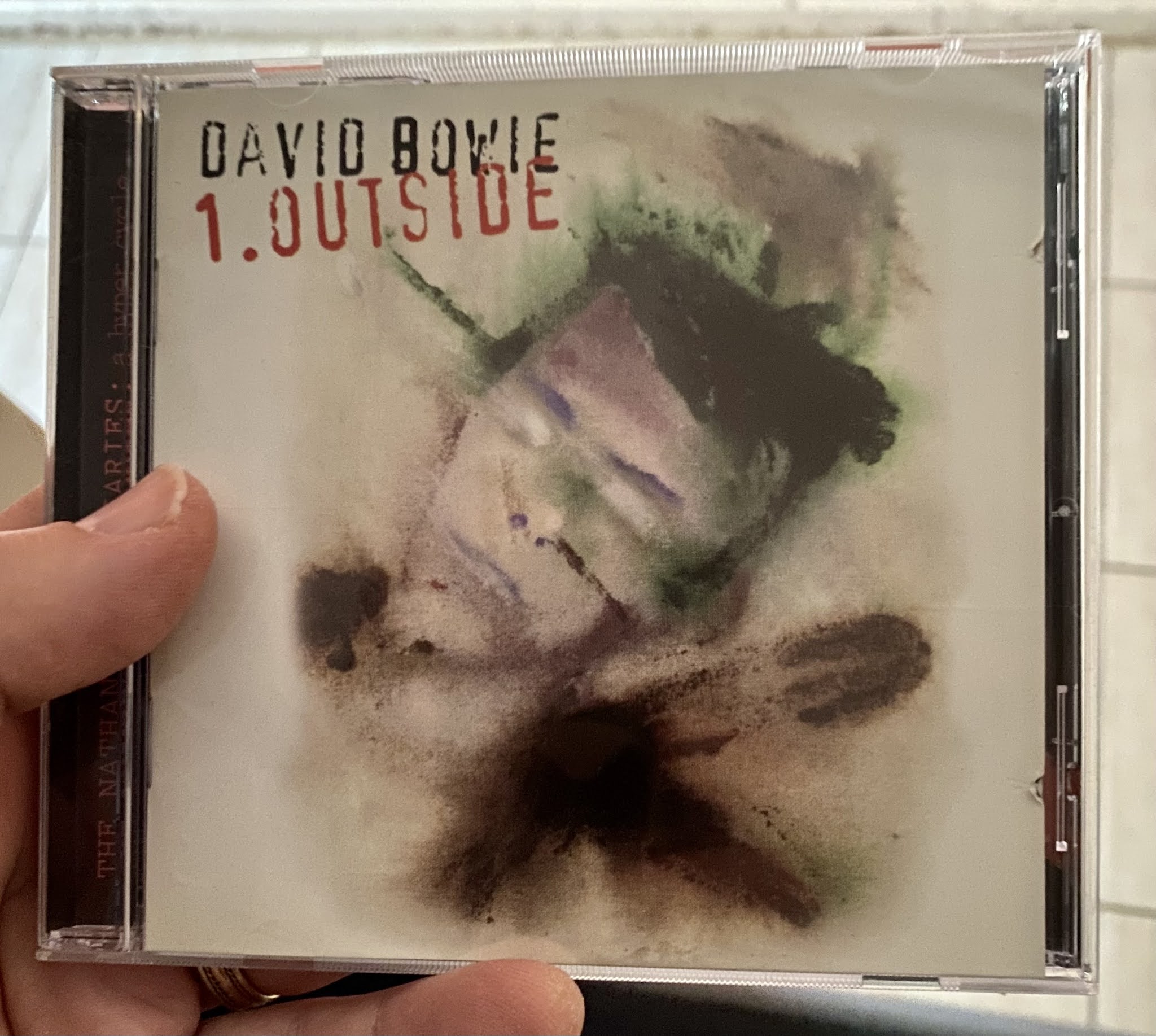
1. Outside

Bowie's nineteenth studio album reunited him with Brian Eno, but this isn't a continuation of their work together during the late 1970s; it is indeed a separate beast. Subtitled The Nathan Adler Diaries: A Hyper-cycle, the album tells the story of a group of characters on the eve of the year 2000, some five years away at the time of release. The record marks its twenty sixth anniversary today, and helped Bowie reach the singles chart in the US for the first time since 1987. 

This is not a casual listen, by any means. You couldn't load this into part of a playlist and hit shuffle, for instance. There are monologues from different characters, sub-plots and a loose narrative throughout. While 1. Outside (or just Outside, I guess) isn't one of my favourite Bowie albums, there are some great moments, and the scope and attempt at storytelling is to be applauded. 

After the scene-setting opening tracks depicting the character of Leon Blank going, you guessed it, outside, the detective Nathan Adler arrives. Cue album highlight The Heart's Filthy Lesson, which would go on to be used to startling effect in the movie Seven. There are numerous remixes and extended version of this song out there, but the album track is pretty damn good. The track was the first single released from the record, followed by Strangers When We Meet, another great song. This was originally written and recorded for Bowie's 1993 'soundtrack' for Buddha of Suburbia, and it's the only track that was written before Outside sessions commenced. So, the version that appears here is a new recording, and a bit more 'lush' than the 1993 one, according to the man himself. Coming at the end of the album, it feels like a breath of fresh air. As this is Bowie's longest studio offering, you've been subjected to almost seventy minutes of story and atmosphere before this arrives to cleanse your earholes. It is one of the few songs here that holds up nicely on its own, along with THFL

The third single, Hallo Spaceboy, was actually rerecorded and remixed in early 1996, and featured the Pet Shop Boys. I have vague memories of seeing the video clip on Rage at the time. I think it may have been the first time I saw a new Bowie video since the eighties. I remember liking it, and thinking it was quite poppy. I thought it was cool that Major Tom was being referred to again. The version on the album is quite different. There are no Pet Shop Boys. The melody remains, but instead of a radio-friendly pop production, it borders on an industrial thudding assault. It is more inline with the rest of the record, than the single release, and works really well among the other tracks. Stands nicely on its own though. If you see any live performances of the song, you'll have flashing lights accompanying the constant thud. Kinda cool though.

There are a few other highlights on the album for me. The Motel got a guernsey on the A Reality Tour on some nights, which is an interesting choice. Without the context of the album, it exists as an eerie character piece. I really like the repeated adage of "there's no hell like an old hell" though. Big on atmosphere and mood, it's not a tune you can easily sing along to, and it's certainly not a stadium anthem either. So, I don't know how well received those live performances were, he he he. I also quite like I'm Deranged, but that's probably due to its usage in David Lynch's eccentric but brilliant Lost Highway

As I mentioned earlier, Strangers When We Meet is the only song that had been written before Bowie and Eno began recording. Joining them were guitarists Reeves Gabrels and Carlos Alomar, bassist Erdal Kızılçay, pianist Mike Garson and drummer Sterling Campbell. Additional contributions were made by jazz drummer Joey Baron and Israeli bassist Yossi Fine. 

In addition to his duties as a co-producer and instrumentalist, Eno is also credited with providing strategies, using flash cards and word randomisers with Bowie to help create characters and songs that didn't rely on clichés. This is a dense, long listen. There is a short essay in the liner notes that help scope out the loose plot of a murdered baby and the people that come in and out of the story. Some of the characters are portrayed by Bowie putting on accents or having his voice manipulated with various effects. As you would probably guess, with it being fully titled 1. Outside - The Nathan Adler Diaries: A Hyper-cycle there was a plan to release another album in the same vein. Ideas from Bowie included putting out an album each year until 2000 and have the music line up with the present, or releasing a trilogy. None of those concept came to fruition. 

So, there is some good, and some bad, the length being the biggest obstacle. One wonders if the bits of narration were removed along with the mood-setting pieces, there would remain a tighter album with some strong songs. Imagine an album that kicks off with The Heart's Filthy Lesson...  It would be a shame to lose those characters and that created world though. 

Bowie's longest studio album is not one I'll probably pull out again anytime soon. I give it 2.5/5.

NEXT UP: Hours... - 4th Oct