Showing posts with label Brian Eno. Show all posts

Friday, 15 October 2021

"Heroes"

The second album of 'The Berlin Trilogy' came out yesterday in 1977. Unlike its predecessor Low, which was released in January of the same year, this record was wholly recorded at Hansa Tonstudio 2 in Berlin. Many of the same personnel from that album are here too with Brian Eno on keyboards (co-writing four of the ten tracks), guitarist Carlos Alomar, bassist George Murray and drummer Dennis Davis. Robert Fripp also contributes some guitar, notably the wonderful lead work on the title track, and Antonia Maaas handles the backing vocals. Tony Visconti is back in the producer's chair with Bowie as well. 

Similarly to Low, the album has several instrumentals, all appearing on the the second side. The record's last track however, The Secret Life of Arabia, does include vocals. While I'm not as big a fan of this album as Low, there is still much to like. The cover itself is arguably Bowie's most iconic, possibly second only to Aladdin Sane

The absolute highlight for me is the stunning title track, which is also among my favourite Bowie songs ever. The production is amazing, Fripp's guitar lines are sublime, Bowie's vocal is incredible and the track is deeply stirring. I'd only heard the single version before buying this album during the Great Bowie Prep of 2003/2004, and I now prefer the longer edit. The use of quotation marks on the title were to evoke a sense of irony, despite the uplifting, almost victorious feel of the song. The couple kissing 'by the wall' were eventually revealed to be Visconti and backing singer Maaas. Bowie spied them embracing from the studio window apparently, although he claimed it was an anonymous couple who inspired the lines. Visconti was married to Mary Hopkin at the time. 

Another highlight is album opener Beauty and The Beast, which I'd first heard on my Bowie Singles Collection CD. There's some rollicking piano, squelchy synths and a fairly galloping pace, with a catchy chorus to boot. Maaas' vocals are excellent, and match Bowie's delivery perfectly. The following track, Joe the Lion has some nice moments, but doesn't quite match the former. I do really like the bridge bit though: "It's Monday/Slither down the greasy pipe..." and so on. The playout is kinda cool too: "Joe the lion/Made of iron..." Sons of the Silent Age and Blackout are both quite good too, with the former being a little more engaging with its slightly eerie mood. 

The second side kicks off with the first mostly (instrumental) track V-2 Schneider which builds slowly, but is one of the album's more upbeat moments. There's a brightness, or airiness here feels quite refreshing and easy to enjoy. You could even call it boppy, particularly when Bowie's saxophone comes in. That feeling is quickly dissipated by the dark and ominous Sense of Doubt, one the most aptly titled pieces of music in Bowie's catalog. Sparsely produced, it's only an ominous piano line that's repeated in between bursts of string synths. I'm quite surprised it hasn't turned up in David Lynch movie. 

Bowie picks up a koto for Moss Garden, which is a Japanese instrument. Fairly ethereal, and a real breath of air after Sense of Doubt. It does the sense of sitting in an eastern garden while the wind blows the tress. The following Neuköln is an interesting piece, with Bowie swapping out the koto for his saxophone. He plays some unconventional notes, making it sound almost unrecognisable as that instrument. Can't say the track does much for me, but it's good to hear Bowie stretching himself. 

So, while it isn't as cohesive as other albums, there's a lot to like, and it does hold your attention. Mostly enjoyed listening to it again, and I give it 3/5. 

NEXT UP: Pin-Ups - 19th Oct

Sunday, 26 September 2021

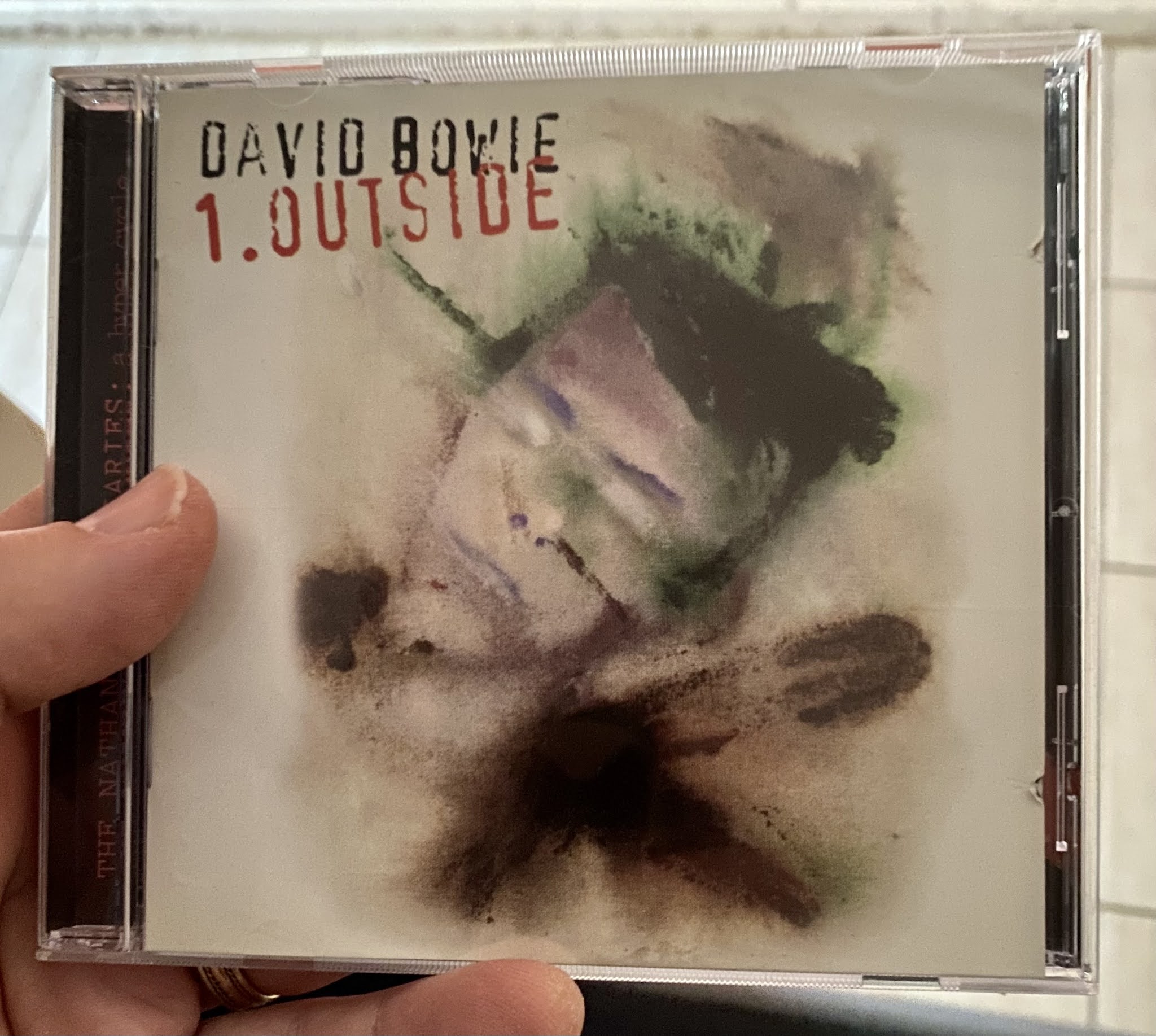
1. Outside

Bowie's nineteenth studio album reunited him with Brian Eno, but this isn't a continuation of their work together during the late 1970s; it is indeed a separate beast. Subtitled The Nathan Adler Diaries: A Hyper-cycle, the album tells the story of a group of characters on the eve of the year 2000, some five years away at the time of release. The record marks its twenty sixth anniversary today, and helped Bowie reach the singles chart in the US for the first time since 1987. 

This is not a casual listen, by any means. You couldn't load this into part of a playlist and hit shuffle, for instance. There are monologues from different characters, sub-plots and a loose narrative throughout. While 1. Outside (or just Outside, I guess) isn't one of my favourite Bowie albums, there are some great moments, and the scope and attempt at storytelling is to be applauded. 

After the scene-setting opening tracks depicting the character of Leon Blank going, you guessed it, outside, the detective Nathan Adler arrives. Cue album highlight The Heart's Filthy Lesson, which would go on to be used to startling effect in the movie Seven. There are numerous remixes and extended version of this song out there, but the album track is pretty damn good. The track was the first single released from the record, followed by Strangers When We Meet, another great song. This was originally written and recorded for Bowie's 1993 'soundtrack' for Buddha of Suburbia, and it's the only track that was written before Outside sessions commenced. So, the version that appears here is a new recording, and a bit more 'lush' than the 1993 one, according to the man himself. Coming at the end of the album, it feels like a breath of fresh air. As this is Bowie's longest studio offering, you've been subjected to almost seventy minutes of story and atmosphere before this arrives to cleanse your earholes. It is one of the few songs here that holds up nicely on its own, along with THFL

The third single, Hallo Spaceboy, was actually rerecorded and remixed in early 1996, and featured the Pet Shop Boys. I have vague memories of seeing the video clip on Rage at the time. I think it may have been the first time I saw a new Bowie video since the eighties. I remember liking it, and thinking it was quite poppy. I thought it was cool that Major Tom was being referred to again. The version on the album is quite different. There are no Pet Shop Boys. The melody remains, but instead of a radio-friendly pop production, it borders on an industrial thudding assault. It is more inline with the rest of the record, than the single release, and works really well among the other tracks. Stands nicely on its own though. If you see any live performances of the song, you'll have flashing lights accompanying the constant thud. Kinda cool though.

There are a few other highlights on the album for me. The Motel got a guernsey on the A Reality Tour on some nights, which is an interesting choice. Without the context of the album, it exists as an eerie character piece. I really like the repeated adage of "there's no hell like an old hell" though. Big on atmosphere and mood, it's not a tune you can easily sing along to, and it's certainly not a stadium anthem either. So, I don't know how well received those live performances were, he he he. I also quite like I'm Deranged, but that's probably due to its usage in David Lynch's eccentric but brilliant Lost Highway

As I mentioned earlier, Strangers When We Meet is the only song that had been written before Bowie and Eno began recording. Joining them were guitarists Reeves Gabrels and Carlos Alomar, bassist Erdal Kızılçay, pianist Mike Garson and drummer Sterling Campbell. Additional contributions were made by jazz drummer Joey Baron and Israeli bassist Yossi Fine. 

In addition to his duties as a co-producer and instrumentalist, Eno is also credited with providing strategies, using flash cards and word randomisers with Bowie to help create characters and songs that didn't rely on clichés. This is a dense, long listen. There is a short essay in the liner notes that help scope out the loose plot of a murdered baby and the people that come in and out of the story. Some of the characters are portrayed by Bowie putting on accents or having his voice manipulated with various effects. As you would probably guess, with it being fully titled 1. Outside - The Nathan Adler Diaries: A Hyper-cycle there was a plan to release another album in the same vein. Ideas from Bowie included putting out an album each year until 2000 and have the music line up with the present, or releasing a trilogy. None of those concept came to fruition. 

So, there is some good, and some bad, the length being the biggest obstacle. One wonders if the bits of narration were removed along with the mood-setting pieces, there would remain a tighter album with some strong songs. Imagine an album that kicks off with The Heart's Filthy Lesson...  It would be a shame to lose those characters and that created world though. 

Bowie's longest studio album is not one I'll probably pull out again anytime soon. I give it 2.5/5.

NEXT UP: Hours... - 4th Oct

Tuesday, 25 May 2021

Lodger

Bowie's 13th album Lodger was released forty two years ago last week, on the 18th of May. I was unable to get a-bloggin' about it then, so here is my a-blog now. Fair enough? The final offering of the supposed 'Berlin Trilogy', even though it was recorded in Switzerland and New York City. One of the big factors connecting the three albums (Low, "Heroes" and Lodger - for the uninitiated) is Brian Eno, who Bowie met in 1976. While Eno co-wrote several songs on these albums, they were helmed by multi-instrumentalist and frequent collaborator Tony Visconti, who produced the albums with Bowie. 

This record stands out from the three as arguably the weakest entry, and the only one not to feature any instrumental tracks. There's also a pop sensibility that permeates the music, despite some experimental sounds and Middle Eastern influences. Another difference is the addition of guitarist Adrian Belew, who Bowie had recently poached from Frank Zappa. Other contributing musicians include bassist George Murray, drummer Dennis Davis, violinist Simon House and pianist Sean Mayes. Frequent Bowie band member Carlos Alomar is also on guitar duties and co-wrote a couple of tracks as well. 

Wow, my thumb obscures the album's title - rookie move.
(Although you can make out 'Lodger' in four different languages below)
I must confess to not being the biggest fan of this offering, but there are a handful of songs I absolutely love. Seeing as it's been a fair few years since my last full listen, now seems like an excellent opportunity to remedy that. Let's go song by song: 

1. FANTASTIC VOYAGE
One of my favourite opening tracks from a Bowie album, and my pick of the songs here. Featuring an absolutely brilliant vocal performance from him, this would probably be in my Top 20 Bowie songs as well. Apparently the track has several overdubbed mandolin parts, three different musicians playing three parts each! Doesn't feel like that much mando, in fact, the song's production feels quite simple to my ears. I was stoked to see Trent Reznor and Atticus Ross do an understated performance of this song for the livestream event, A Bowie Celebration, early this year. It was included in Bowie's live document A Reality Tour as well, much to my delight. Short and sweet, I actually hit repeat twice before listening to the rest of the album. The song is also the first of six songs that were co-written with Brian Eno.

2. AFRICAN NIGHT FLIGHT
There's a lot going on here. Bowie's vocal delivery borders on annoying and there's too many lyrics to take in at times. I'm sure it's the product of Eno's bizarre 'Oblique Strategies cards', but it feels like noisy filler. Interesting Middle Eastern hook, but it's a bit of mess, for mine.

3. MOVE ON
Another song that's not that memorable. Some nice vocal harmonies and a pleasant enough listen, but nothing that sticks with you. 

4. YASSASSIN (TURKISH FOR 'LONG LIVE')
Not the greatest track here, but I do like the melody of the repeated 'yassassin' with the call and answer responses: "I'm not a moody guy/I walk without a sound". Almost a ska/reggae vibe on this one, complete with wobbly organ part. 

5. RED SAILS
Now, I don't mind this one. The vocal line is quite hooky and I found myself singing the "thunder ocean" bit repeatedly after my first re-listen. The melody-mirroring saxophone was provided by Stan Harrison, not Bowie himself. I do find it bizarre when he doesn't play the sax. Belew sounds like he was finally let off the chain a bit here too. The album itself starts to get a bit more interesting from this point on. 

6. DJ
One of a handful of songs that started to appear deriding the radio industry, the attitudes of those who helm the song choices and the decisions of what makes the airwaves. I first heard this track on the 1993 compilation Singles Collection Vol. 2, and took a while to warm to it. I dig it a lot more now, and it's certainly one of the album highlights. Co-written with Alomar, this song features a lot of guitar work from Belew and a memorable chorus line: "I am a DJ/I am what I play". 

7. LOOK BACK IN ANGER
Not a bad track, but doesn't really go anywhere. It seems like it stays in the same place without really moving forward, despite the galloping feel of the song. Bowie's vocal performance is terrific though, and the sound production of the band is pretty good.

8. BOYS KEEP SWINGING
Possibly the album's most renowned track, and another big highlight for me. The instrumentation and arrangement reminds me of early Roxy Music. I really love the bassline, which was re-recorded by Visconti after the experimental idea of the musicians swapping instruments didn't quite work. That's Alomar on the drums! He he he... I only just learned that this song also has the same chord progression as Fantastic Voyage. Now, I can't stop swapping the two songs around! 

9. REPETITION
A harrowing account of domestic violence, belied by the track's bouncy bassline. Bowie's near-emotionless vocals are especially chilling, as it would seem the song's narrator has no qualms about beating his wife. Not really an enjoyable listen, but an interesting one. 

10. RED MONEY
The album's final offering isn't too bad, and has Eno playing that synth sound throughout. Some nice crunchy guitar, and overdubbed vocals. Again, like some previous tracks, it feels a little meandering and comes across as filler. Its fadeout is almost merciful, as the song feels like it could just keep going. 

All in all, it's not brilliant, but has its moments. I give it 3 out of 5. Would listen to some of it again.

NEXT UP: Diamond Dogs. Eeep! This one was a little late...