Wednesday, 4 September 2024

Ten Things I Love About Dylan

Okay, my tenth Dylan blog sees me in good company, album-wise. After ending the last one with 1997's excellent Time Out of Mind, we've got some more great listening ahead! It's been tough going, but we got there. Read on...


37. LOVE AND THEFT (2001) (29/8/24)
Bizarrely, this is one of a handful of albums with the infamous release date of the 11th of September, 2001. Ben Folds' solo record Rockin' the Suburbs and Jay-Z's The Blueprint also came out that day, along with releases from Slayer, Nickelback and Mariah Carey. That notoriety aside, this stands as another classic Dylan release in his late career. Continuing on from the strength of Time Out of Mind, Love and Theft is just as strong, if not quite as compelling. Rather than deep meditations on life and mortality we are presented with a number of stories and characters. 

Indeed the opening track, Tweedledum and Tweedledee, is just a mish-mash of clichés thrown together into a foot-tapping bluesy stomp, which feels like a parody of any song that ever used clichés. There is a loose story there, and the two characters, of course, but it's playful, and I reckon it's just Dylan warming up and having fun. We've come a long way from Wiggle Wiggle! The second track is Mississippi, now hailed as modern Dylan classic. It's a great tune, and has a studio take that befits it after failing to make the cut for TOoM. Rounding out the 1-2-3 punch is Summer Days, a rollicking slice of rockabilly, old-timey swing-rock and barn-burning hootenanny! Great way to kick off the record.

Dylan's 31st studio offering is one of his best albums of the last 25 years, and his first great album of the 21st century. This is also the first time he's credited himself as Jack Frost for the album's production. A part of his touring band at the time, guitarist Charlie Sexton makes his first of many appearances, adding to a wonderful backing group for Dylan, including drummer David Kemper, bassist Tony Garnier, guitarist Larry Campbell and Augie Meyers on accordion and keys. Other highlights for me include Po' Boy, Honest With Me and the time-shifting Cry a While. Great album!


38. MODERN TIMES (2006) (30/8/24)
After two fantastic albums, expectations were high for Bob Dylan's next long-player, and did he meet them? Did he, heck! Modern Times rounds out a trilogy of masterful original releases not seen since his high watermark of Bringing It All Back Home, Highway 61 Revisited and Blonde on Blonde in the mid-sixties. Once again, Dylan produces the album himself under the name Jack Frost. Keeping only bassist Garnier from Love and Theft, recruited musicians for this record are guitarists Denny Freeman and Stu Kimball, drummer George C. Receli and multi-instrumentalist Donnie Herron. The latter's gorgeous steel guitar playing are a hallmark on this excellent album, featuring prominently on tracks like Spirit on the Water and When the Deal Goes Down.

At the risk of overusing the word, the album gets off to a rollicking start with the opener Thunder on the Mountain. An assault of guitar solos and hilarious lyrics, this is one of my favourite Dylan tracks of this century. It has one of his more puzzling references to pop culture in there:

I was thinking about Alicia Keys, couldn't keep from cryin'/
When she was born in Hell's Kitchen, I was livin' down the line/
I'm wondering where in the world Alicia Keys could be/
I've been looking for her even clear through Tennessee

No idea what he's on about, and what his infatuation with Alicia Keys is, but it's funny to hear him sing her name. This album also contains a few other bit favourites of mine, the aforementioned Spirit on the Water, the epic closing track Ain't Talkin' and the ode to the working classes, Workingman's Blues #2. The latter was penned by Dylan as an unofficial sequel to Merle Haggard's 1969 hit Workin' Man Blues. I initially thought the '#2' reference was to an alternate version or a rewriting of an unreleased song of that name. It's a great song, and one I never get sick of hearing, like the whole album in general. One of the weaker tracks (in my opinion), Nettie Moore, also gets high praise, but I feel it's not as engaging as other songs. It's still a good one though! Dylan's riffing on the blues classics Rollin' and Tumblin' and When the Levee Breaks (reworked into The Levee's Gonna Break) are also very enjoyable. It's an absolutely top notch effort from Dylan, and one of my big favourites.

39. TOGETHER THROUGH LIFE (2009) (1/9/24)
Okay, now things start to get a little rocky. He he he...not to say that this is a bad listen, but it's certainly Dylan's weakest offering since Time Out of Mind. The songs aren't as immediate, and did somebody say piano accordion? The album is rife with it, giving the songs a swampy, zydeco-type feel; which comes courtesy of David Hildago, who also contributes guitar. Drummer Receli, bassist Garnier and multi-instrumentalist Herron all return to the fold, with ex-Heartbreaker Mike Campbell throwing in some strings and things as well. Dylan's production duties are again present in the form of his alter-ego Jack Frost. 

The big change to this effort, is that except for two tracks, the lyrics have been co-written by Dylan with Robert Hunter, formerly of The Grateful Dead. That doesn't dampen Dylan's vocal delivery, and the sense of humour keeps in line with His Bobness too. There's just nothing that really grabs you. My favourite tracks include album opener Beyond Here Lies Nothin', My Wife's Hometown and Jolene (no, not that one). The record's final track really falls flat, for mine, as Dylan tries to use a popular phrase (It's All Good), and doesn't land it. Forgetful Heart seems to be lauded by some too, but I don't see anything special about that one either. Not bad, but not great. 

40. CHRISTMAS IN THE HEART (2009)
Now, here's a big surprise...a Christmas album! And not a quick, by-the-numbers, I'll-get-out-a-Christmas-album-for-the-holidays moneymaker, but a sincere and well-thought out affair. Coming out less than six months after Together Through Life was released, Christmas In the Heart is an album for Dylan fans who love the yuletide season. This certainly won't win him any new fans though.

Keeping the same personnel from TTL (bar Mike Campbell), Dylan adds guitarist Phil Upchurch and keys player Patrick Warren. Oh, and there's a fair few burst of choir as well, of course! The latter adding Christmassy weight to carols such as The First Noel and Hark the Herald Angels Sing. Along with the traditional fair, there are also great versions of Here Comes Santa Claus, Have Yourself a Merry Little Christmas and I'll Be Home for Christmas

The absolute highlight though, and I would even say the album's centrepiece, is the polka-styled version of Must Be Santa, an old Christmas song released in 1960 by Mitch Miller. A call-and-response number, that builds similarly to The Twelve Days of Christmas, this sees Dylan in full 'ho-ho-ho' mode. While it's not an album for every day of the year, it's nice to dust off in December.


41. TEMPEST (2012) (3/9/24)
This album is the last record in the Dylan box set that begat this whole series of blog posts. This is the 45th CD, but not the last entry. That honour goes to the Side Tracks compilation (discs 46 & 47), which is made up of singles, live versions and other previously unreleased material. That set is unique to The Complete Album Collection Vol. One box. I might have to give Side Tracks its own post.

Annoyingly, Dylan has released five more albums since the set's release in 2013. So, the box is now outdated, and incomplete. Even more annoyingly was the failure of the proposed Vol. Two box set, which would have collected all of the Bootleg Series compilations together. There's still time, I guess! 

Of the five recent albums, three of them are made up of cover versions (Shadows in the Night, Fallen Angels and Triplicate), one is Shadow Kingdom, the soundtrack to his 'livestream' concert of reworked classics from 2021, and 2020's excellent studio effort Rough and Rowdy Ways. Again, I may need to blog about those offerings in the future.

But, I digress! Tempest is a great album, and one that I wish that was more familiar with when we saw His Bobness live for the third time at the Riverside Theatre, PCEC in August 2014. No less than six tracks from the ten track long Tempest made the setlist that night. Kicking off with the excellent modern-Dylan classic Duquesne Whistle, the scene is set for another fab record minus the excessive piano accordion. Another classic track on offer here is the growling Pay In Blood which features such excellent lyrics as:

My head's so hard, must be made of stone/
I pay in blood but not my own

Other album highlights for me include the bluesy Early Roman Kings, the riff-tastic Narrow Way and the plodding Lost and Wasted Years. The epic title track nearly hits the fourteen minute mark, and is a sprawling account of the sinking of the Titanic. Certainly worth a listen, but not essential. The same could be said about his tribute to John Lennon, Roll on John. It comes across a little laboured, almost like he didn't really want to write it, but there's some sentiment there, I think.

All songs on Tempest are written by Dylan himself, except for the opener, which he co-write with Robert Hunter. He's also produced the album as Jack Frost once again. The band is the same as his Together Through Life line-up, minus Mike Campbell and with the addition of guitarists Charlie Sexton and Stu Kimball. A nice way to end the albums in this box set, and with it, this tenth entry in my blog post series. I'll add an addendum shortly in the future!

Wednesday, 28 August 2024

Who Watched Watchmen?

I can’t remember exactly when I bought the Watchmen graphic novel, but it was before Zack Snyder’s film adaptation came out in 2009. That might have been the impetus behind me buying it. I didn’t watch the film until I’d read the book, and I missed its theatrical run, so I ended up with the original Aussie Blu-ray release. 

Anyway, the reason for this blog is that I’ve just re-read the book and watched The Ultimate Cut on Stan (and I'm in the middle of re-reading it again). That version is the Director’s Cut which incorporates the animated Tales of the Black Freighter comic into its three and a half hour running time. Initially available as a separate purchase, TotBF is woven through this version of the movie similarly to how it appears in the graphic novel. The use of animation is quite effective, as it fleshes out the story a little clearer than the limited comic panels in the graphic novel. 

I should probably SPOILER ALERT you right here. If you haven’t read the book or watched a version of the film, and you don’t want to know any plot points, stop reading. 

The graphic novel is an amazing piece of work. Written by the acclaimed and revered Alan Moore and illustrated by Dave Gibbons, it is an amazing exploration of an alternate world where superheroes existed, and then became outlawed in 1977. How would costumed vigilantes have changed the course of history and what happens when the world gets tired of them? Set in 1985, the little differences between our current world, their fictional world and our world at the same period make this quite compelling. As the US govt utilised the powers of Dr Manhattan, not only did the USA win the Vietnam War, the country became America’s 51st state! Due to Woodward and Bernstein being killed by mobsters and therefore unable to expose the Watergate scandal, Nixon not only stayed in office, he extended the presidential terms and remains commander-in-chief in 1985! 

It’s not a linear narrative, as events in the past flashback throughout the story and some plot details are included as supplementary inclusions at the end of each chapter. The Watchmen graphic novel is made up of the 12 months issues of the Watchmen comic series that were published in 1986 and 1987. I wish that I had read them when they initially came out! Some chapters finish with excerpts from Hollis Mason’s Under the Hood, a novel by the costumed vigilante known as Nite Owl from 1939 to 1962. Others include appendixes of magazine articles or notes from a personnel file. It makes for a very immersive read! The weakest of these, for me, was an ornithological essay by Dan Dreiberg, who became Nite Owl II in the sixties. Drieberg is a main character in the events of 1985 and appears in various flashbacks. 

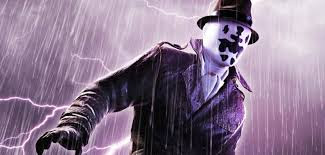
Both the film and graphic novel begin with the murder of Edward Blake, who is discovered by main protagonist Rorschach to be The Comedian. He was a member of a group of superheroes called the Minutemen in 1940 who went on to work for the US govt. The Comedian’s death is symbolised by the iconic image of a yellow smiley face badge with a splatter of blood on it. This image recurs throughout the comics and the movie. Rorschach is a ruthless character who sees the world as one in need of justice, and in his case, that justice is sometimes brutal. Taking his name from the psychological ink blot test, he wears a white mask with black liquid between the layers of fabric, which makes for a constantly changing Rorschach test. As we read (or watch) on, he believes this to be his true face and is not simply posing as Rorschach, he IS Rorschach. He might have been born Walter Kovacs, but one horrible encounter during a kidnapping incident changed him into Rorschach forever. His mask is the only face he feels he change show the world, seeing his mask-less face as his disguise.

Rorschach narrates part of the story, with his narrations coming from his journal. This gives us more insight into his character than any other, and despite his violent tendencies and extreme viewpoints, you find yourself sympathising with him and his plight. Jackie Earle Haley's performance as Rorschach in the movie is one of its biggest strengths. Among the numerous differences between the film and the graphic novels is one of my favourite changes, and it's only a small thing, but it gives Rorschach an awesome movie moment. 

When Rorschach is sent to prison, there is a scene where he's confronted by another prisoner, who threatens to shiv him in the canteen. Responding quickly, and without fear, Rorschach hits him upside the head with a tray and breaks the glass protector sheet between the queue and the kitchen servery. He proceeds to grab a boiling pot of oil and pours it over the hapless prisoner. As he is being restrained by prison guards, he yells out to the all of the onlookers:

"None of you seem to understand. I'm not locked in here with you, you're locked in here with me!!"

This whole incident is acted out in the movie, and Haley is brilliant in it. The graphic novel gives a second hand account of it via Malcolm Long, Rorschach's psychiatrist in prison. It has so much more menace and vitriol seeing the scene happen in person, rather than the line being relayed from another character. Nice work, Zac!

Of course, the crowning glory of the movie adaptation has to be the opening credits. Taking place straight after the murder of Blake, the titles are shown over a montage of scenes that depict the 1985 that this movie is set in, highlighting some events that have lead to it. A few of these scenes are only vaguely alluded to in the graphic novel, and to have them implicitly re-created in these little vignettes shows how much Snyder and his team mined from the source material. For instance, a superhero from the forties, Silhouette is shown kissing a nurse on VJ-Day in Times Square, referencing the famous photo of a sailor kissing a nurse on the same day in our timeline. It is hinted that the sailor is walking behind Silhouette, and so misses out on the kiss and the photo. This reveals that is superhero is a lesbian, and that things have become quite different, but the media still wields a lot of control. Another later scene in the titles show the nurse and Silhouette have been murdered in a bedroom, with a newspaper showing their famous kiss next to the bed. 

The existence of Silhouette is referenced more in the graphic novel, but if you hadn't read it, you wouldn't even know her name. The movie shows her death which is only referenced to in an interview with Silk Spectre, who laments the way she was turfed out of the Minutemen...the first group of superheroes who banded together in 1940. She explained that one reason she was ousted was due to her sexuality, even though there were other members who were gay. We find out in the 2017 HBO TV series Watchmen, that this may have meant Captain Metropolis and Hooded Justice. 

This is just one example of the movie fleshing out a small detail of the graphic novel. Getting back to that opening credits sequence, each vignette is presented like a photograph (or being itself photographed) except for minor movement, or slow motion. It's underscored by Bob Dylan's immortal The Times They Are A-Changin', and it fits perfectly as the years get closer to 1985. We learn that The Comedian was involved in the death of JFK, who had been at a media conference with Dr Manhattan in another scene, and that members of the Minutemen have either been killed, committed to a mental asyulm or retired. While the new group of superheroes consisting of Dr Manhattan, The Comedian, Silk Spectre II (the original's daughter), Ozymandias, Nite Owl II (protege of the original Nite Owl) and Rorschach is thought of as many as the Watchmen, they are never named as such in the novel. In fact, the famous quote 'Who watches the Watchmen?' is never shown in full in the comic either; it's always obscured. The quote itself is from Roman poet Juvenal who asked 'Quis custodiet ipsos custodes?' in reference to the guards posted to ensure the fidelity of his wife. 

As I've mentioned before, some of the casting is absolutely spot-on. Haley as Rorschach, Patrick Wilson as Nite Owl, Jeffrey Dean Morgan as The Comedian and Billy Crudup as Dr Manhattan are all terrific. I think Carla Gugino was a little miscast as Silk Spectre, and didn't really work in the older guise or as the younger character. She had great potential, but it didn't land for me. Same with Malin Akerman as her daughter Silk Spectre II (Laurie). Something was a bit off. She didn't have the spark and spit of the comic book character. Matthew Goode's casting as Adrian Veidt was another mistake, I feel. Again, he just didn't embody the character right for me, although he gave it a damn good go. The actor portraying Richard Nixon was pretty unconvincing as well, I felt.

The biggest difference between the graphic novel and the movie that I absolutely hated was Veidt blaming the destruction to the human race at the conclusion of the story on Dr Manhattan. In the comic, a giant squid has been created by artists, scientists and other experts by Veidt, with the masterplan being that it appears in New York City, as if from another dimension, dead but affecting the deaths of over three million people. The movie has several locations all over the world that appear to have been random targets of Dr Manhattan's deadly powers, but they have been instigated by Veidt with the express purpose of uniting the world against a common enemy, and avoiding World War III between the USA and Russia. 


The death of The Comedian at the start of the story sets Rorschach on an investigation that leads him to think that someone is trying to kill the old superheroes. Other events include Dr Manhattan seeking refuge on the planet Mars after falsely believing that he has given former co-workers and friends cancer, and an attempt of Veidt's life. Rorschach is sent to prison after being framed as the killer of Moloch, an old enemy of the Minutemen/Crimebusters who had since reformed and lived the life of a civilian. It turns out that Veidt was behind all of it, hiring his own hitman before killing his would-be assassian under the subterfuge of trying to pull a cyanide pill out of his mouth; when he actually crammed it in himself. 

Veidt's motive is the same in the graphic novel, but the blame is put on an alien entity that has seemingly appeared from another dimension, and poses a possible threat of alien invasion. This threat was meant to unite the world, which we are told it does in the comic, and the later TV series. Apparently this element of the plot was eliminated from Snyder's adaptation because he felt he would need at least 15 minutes to explain it. Time he felt would be better spent on developing the characters. Yeah, maybe. Don't like the change. 

Again, in both scenarios, Rorschach doesn't agree to keep the real source of the destruction a secret, and is bent on getting the news of Veidt's scheme to the people: "Never compromise. Not even in the face of Armageddon." In both the film and the comic, he is killed by Dr Manhattan who believes that the world will be better served if the human race never learns the truth. The big difference in Rorschach's death scene is that the movie shows Nite Owl watching and yelling out a nice big "Noooooooooooooooooooo!" as Rorschach's body is torn apart by his blue executioner. Unnecessary change, I felt, but I guess it adds to the emotion of the moment. I don't like the way Rorschach's character dies (or that he dies at all, really), but I see it like a suicide. Rorschach must know that Dr Manhattan will kill him, and the doc must realise there is only one way to stop Rorschach from spreading the news. 

It gives you more sympathy for Dr Manhattan's actions in the movie, because he realises that he is going to have to take the blame for Veidt's massacres. The good it will do for the planet outweighs the truth, and in killing Rorschach he seals his own fate. I don't like that Rorschach dies, and he's not exactly a model citizen, but it feels like his character drives the story. So, I guess it's kind of fitting that once he dies, the story nearly is as well. 

Both the movie and the comic hint that the journal Rorschach mails to the New Frontiersman paper (unnamed in the movie, I think) will see the truth come out anyway, which makes it all a bit baffling. But that's the fun of it. There's a few ways the future could pan out, but its up to the individual reader or viewer.

In conclusion, I think the graphic novel is the best way to enjoy Watchmen, but the Ultimate Cut of the movie is probably the closest we'll ever get.

*        *        *        *

After reading the comic, then watching the movie, then re-reading the comic, I watched the HBO TV series. And although I found it quite interesting, and certainly compelling in places, when it was all over I was like "Um, okay." I liked the premise, in that it is set in 2019 after the events of the comic in 1985. A giant squid killed three million people in NYC, the same as the comic. 

In this alternate world, members of the police wear masks to protect their identity. This is due to a massacre of police officers, dubbed 'White Night' that occurred years before, due to the ease of finding their personal details. This was carried out by a group called the Seventh Kavalry, who for some reason wear Rorschach masks. This is never really explained, but I'm guessing it's to show a strange camaraderie to him, embracing his more right-wing qualities and painting him falsely as modern Klansman. I didn't like that idea, but the device of police having to be masked was interesting. It further blurred the line between masked vigilante and law enforcer.

I also liked that the character of Laurie Jupiter (Silk Spectre II) had becomes an FBI agent going by the name of Laurie Blake. She learnt that The Comedian was her father after his death, and knew that he had attempted to rape her mother. In spite of this horrible act, it seems that both The Comedian and Silk Spectre engaged in consensual relations, with Laurie being born from that encounter. After hating Blake for many years after learning of the sexual assault, she is devastated to learn that he is actually her father. That her character goes by Laurie Blake in 2019 shows that she must have made peace with that fact somehow. She is wonderfully played by Jean Smart, who is pitch perfect. Someone with the same energy and delivery should have been considered for the movie.

Overall, I thought the casting was excellent, and Regina King carries the show with her performance bearing its weight with ease. Her Angela Abar is similar to Rorschach in Watchmen, as she drives the story, and most of the action is seen from her point of view, baring the Veidt storyline on Europa. Tim Blake Nelson is wonderful as masked police officer called Looking Glass, as his head covering is fully reflective. Don Johnson is great in a small role as the chief of police before being assassinated, casting doubt on his true motives and on whether he was a member of the Seventh Kavalry himself, in spite of pursuing them. Jeremy Irons is an interesting choice as Veidt (who spends most of the series imprisoned on Europa, which is a moon of Jupiter). I felt at times it worked, then at other times his character seemed unnecessarily cruel. Indeed his character in the comic was quite narcissistic, but there was a gentleness to him; until he needed to not be gentle. Again, a British actor used to portray Veidt which I find bizarre, but maybe that was to add an air of pomposity to him? 

Yahya Abdul-Matten II plays Angela's spouse Cal, and is very good. Particularly when it is revealed that he is not who he seems. I felt the actor who played a character called Will Reeves, Jovan Adepo, was excellent as well. It was a thrill to see the older character Reeves played by Louis Gossett, Jr too. Their character survived the Tulsa 'Black Wall Street' massacre in 1921 and is eventually revealed to not only be Hooded Justice, the first masked vigilante, but also Angela's grandfather.

There are numerous references to the original graphic novel, which does reward fans, but also enhances the world they are living in. Some nice plot points include Veidt orchestrating random showers of smaller alien squid to perpetuate the idea that invasion is still possible. Robert Redford has indeed become president, as hinted at the end of the comic, but we don't get see him unfortunately. A few scenes are set in Vietnam (now a state of the USA), and Dr Manhattan is almost worshiped as a deity, or derided as a devil, for his actions in ending the war in the sixties.

It won a heap of Emmy awards, with Regina and Yahya receiving the top gong in their categories and apparently had the highest number of nominations for a TV series ever. Among its swag was Outstanding Directing, Writing and TV Movie/Limited Series. Some categories saw multiple nominations, with Outstanding Supporting Actor getting nods for Louis, Yahya and Jovan. Trent Reznor and Atticus Ross also garnered awards and praise for the music, which is also very good. 

But yeah, by the end of it, I felt a little underwhelmed. I think the destination wasn't as good as the journey, which could be said of the original Watchmen graphic novel as well, I guess.

Thursday, 8 August 2024

Album of the Week - Vol. 25

THE NATIONAL Trouble Will Find Me (2013)
Week: Tue 31st Jul to Mon 5th Aug 2024
Format: Vinyl, iPod
Producer: Aaron Dessner, Bryce Dessner & Marcus Paquin 
Tracklisting: 
SIDE 1
1. I Should Live In Salt *
2. Demons
3. Don't Swallow the Cup *
4. Fireproof
SIDE 2
5. Sea of Love *
6. Heavenfaced
7. This is the Last Time
SIDE 3
8. Graceless *
9. Slipped
10. I Need My Girl *
SIDE 4
11. Humiliation
12. Pink Rabbits *
13. Hard to Find *

TOTAL RUNNING TIME: 55:06

For years, The National was the name of a band I didn’t know anything about. I couldn’t have told you any of their songs or the titles of any of their albums. Although, the cover of this album did leave an impression on me when I first saw it; I was a little horrified by it. I didn't know the name though. I now know that this is the sixth studio offering from the group.

My first inkling to give them a listen came from a guest at a wedding I was playing at down south. I got talking to a fellow on my break about the band, and I confessed that I didn't know their work. He proceeded to recommend three songs of theirs to me:

1. Bloodbuzz Ohio
2. Fake Empire
3. I Need My Girl

I actually typed them into a Note on my iPhone, with every intention of checking them out. The date on the Note was 24th February, 2018. Pre-COVID. Pre-studying for counselling.

Fast forward to mid-2023. We find out that one of our favourite bands is coming to Perth, Fleet Foxes. They'll be playing in Kings Park, one of our favourite venues. But, they are a support act for The National. The National? Oh yeah, that band I never got around to listening to. Maybe I should delve a little. 

True story, those three songs from the aforementioned wedding guest were my launch pad. To the Spottersfy! The concert was happening in March 2024, so I had about six months to get as familiar with their material as I could. Those three songs were taken from their fifth album High Violet, their fourth album Boxer and this album respectively. I would focus much of my listening on these records. 

In addition to using Spottersfy, I also looked to the YouTubs to watch some music clips of the band as well. This yielded numerous spins of Bloodbuzz Ohio, as well as Graceless and Sea of Love, both of the former also coming from this album. I was digging them. I was quite surprised at how low the voice of lead singer Matt Berninger was. He has a timbre that is a mix of the baritone of Leonard Cohen, the melancholy of Nick Drake and a dash of a snarling Nick Cave. It makes their sound quite unique, and the dual guitar play of brothers Aaron and Bryce Dessner is always fairly textured and varied. Drummer Bryan Devendorf always seems to be the most energetic player, excepting their quieter numbers. He locks into brother Scott's bass playing with the ease you'd expect from family musicians.

January is my birth month, and as I was asked for ideas of presents from my family, I offered up the idea of some physical copies of albums of The National. Expecting them to be easy to find on CD, I was elated when my birthday came and one of my gifts from the fam was this here album on Coke glass bottle coloured vinyl; the 2022 reissue. I can see why someone wouldn't dig the band, but I've since become quite the fan, and it was very cool to listen to so much of the music and then see them live.

Thought I'd give this album a fair few spins over the week, away from all that cramming in the leadup to the Kings Park show. I've still got a bit of listening to do to take in their full rep, but I'll get there. There are a few live concerts on the YouTubs which have also been great to take in. But, disturbing cover image aside, this is a great listen, and I've become quite fond of this album.

Kicking off with I Should Live In Salt, The National deliver a consistent sound to their previous material, which I now appreciate. It's a mournful song of regret, which suits the band well. The sonic atmosphere is limp and plodding, but with the odd squeal of guitar among its syncopated rhythm. It's a big highlight for me, but it's followed by Demons, which is my least favourite track on the album. I think it's the one track where the depth of Berninger isn't an asset, it's a weight. It's nigh-on impossible to singalong to and doesn't have much in the way of hooks. Bizarre, considering it was a single.

Thankfully, that's the record's nadir out of the way and the going gets better from here. Album standouts Don't Swallow the Cup and Sea of Love come in quickly, the latter featuring one of my favourite videos in recent years. If you haven't seen it, click here. The clip itself was inspired by a Russian music video by an eighties art rock group called Zvuki Mu. In fact, it's pretty much the exact same clip, but arguably The National's child guitar-mimer is a bit more charismatic. Check that video out here, you know, if you're interested in comparing. As well as having a great music clip, Sea of Love also includes the album's title in its lyrics, which is my favourite way of an album getting its name:

"If I stay here/Trouble will find me
If I stay here/I'll never leave..."

The midpoint of the album, and the first song on Side 3 is Graceless, another album highlight, and another great accompanying video. Shot in black and white, it depicts the band on some kind of boys' day out or stag do. Beer is involved, as is a bouncy castle, a slip-and-slide, a potato gun and other hi-jinx. Strong contender for my favourite song here, with a great energy and fab lyrics. This is the last track that gets your foot tapping though, as the record mellows out considerable from here. Not that that's a bad thing. In fact, the last two songs, are two of the best, Pink Rabbits and Hard to Find. The latter is particularly hypnotic, and makes me feel at ease. 

Considering how this album made me feel when I first saw its cover, I find it incredible how much I revere it now. If they hadn't toured Australia with Fleet Foxes in March this year, I might never have listened to it. Thankful for that.

Sunday, 10 March 2024

Dylan on Cloud Nine

My ninth blog post of Dylan's albums sees me stuck in the 90's! By gum, it's been a little while. Almost a year or so! Not really been looking forward to listening to some of these, but hey, let's get down to business!

33. GOOD AS I BEEN TO YOU (1992) (9/2/24)
Consisting of Dylan performing solo on a acoustic guitar (with the odd burst of harmonica), this album of covers is pleasant background listening, but nothing earth-shattering. I'd not heard track one from this album before giving it its maiden spin, and I wasn't very familiar with the songs he'd chosen to include. Of the thirteen tracks, I only knew Hard Times and Froggie Went a Courtin', and a couple of songs I think I had heard of, like Sittin' on the Top of the World. Most of the tracks are old folk tunes from the UK and now reside in the public domain. These are the songs that must have been a big influence on Dylan as he rose up through the folk scene in the early 1960s. So, from that point of view, it's interesting to listen to him offer up songs that made a mark on him, but it's not why most of us choose to put on a Bob Dylan album. His next album would be a similar offering, but it's this period in time that gives Dylan a bit of a reset as he ponders what his next original album will be like. Similar to his burst of inspiration that gave birth to Oh Mercy's Political World, another well of songwriting was about to gush through the surface. However, that album is still five years away.

I can't see me ever spinning this record again, and I don't think I'll ever spend enough time with it to have any real favourite tracks. It's nice to listen to, but not an album I'd turn to. Feels like you're eavesdropping on him in his hotel room or backstage somewhere as he rips through some of his favourite songs to play. It's kind of cool, but kind of not at the same time.

34. WORLD GONE WRONG (1993) (13/2/24)
Okay, so here we are again with another album of acoustic covers. Interestingly, in between these last two records, Columbia honoured Dylan with The 30th Anniversary Concert Celebration, which was recorded in Madison Square Gardens during October 1992, and released in August 1993. Earlier, in 1991, the Recording Academy also chose to honour His Bobness with their Lifetime Achievement Award. These are the sorts of events that usually occur at the end of someone's musical career. Dylan may have thought that the cards were stacked against him as far as releasing new original material went, and that might have been another reason behind his choice to issue two covers albums. Was he expected to just quietly bow out? Yes, the eighties were a difficult period for him, but he still managed to deliver two great albums in 1983's Infidels and 1989's Oh Mercy. 

But, back to the album in question. I actually enjoyed this much more than the former offering. Same concept, it's just Dylan playing acoustic covers, but the vibe seems so different. I knew even less of the songs on this one, having only heard various versions of Stagger Lee (here titled Stack a Lee) before and his go at Blood In My Eyes, which was included on the bonus DVD that accompanied the special edition of Modern Times. I'm not sure if the rawness that permeates this album is due to it being produced by Dylan himself or if the song choice is the defining factor of difference. Good As I Been To You was produced by Debbie Gold and seemed a little sterile in comparison. Arguably, his performances are just as good on both albums, but this one seems so much more listenable. I really dug the title track, Delia and Love Henry as well, the former seeming very similar to Nick Cave's Henry Lee. 

I think these albums were a bit of a reset for Dylan. Rather than thinking about what he should be doing and releasing, he just went back to the songs that inspired him. In doing so, he probably planted the seeds of what would lead to an output of outstanding albums starting with 1997's Time Out Of Mind. However, before we get to that offering, we need to talk a look at...

35. MTV UNPLUGGED (1995) (19/2/24)
Recorded over two nights in November 1994, this live album captures much of Dylan's performance on the MTV Unplugged television series. Back in the day, anyone who was anyone had an Unplugged record out or had at least appeared on the TV show. I have vague memories of giving this a spin when it came into stock at Southern Sound in Albany while I still worked there. Only being schooled in the more well-known material of Dylan at the time, I was not very familiar with His Bobness' song selection, who was 53 at the time of the recording. Indeed, two of the tracks weren't officially released at the time, John Brown and Dignity. The latter I know now from the Tell Tale Signs (The Bootleg Series Vol. 8) collection that spanned 1989-2006. The demo version, which is just Dylan on piano is included on that set, as well as a band recording from sessions in 1989. It wouldn't see an official release until 1994 when it became a single from his Greatest Hits Volume 3 album. 

The former, John Brown, was actually written by Dylan in 1962 and recorded in early 1963 and released on a folk compilation under the pseudonym Blind Boy Grunt. A protest song about a young man injured during the war, it hasn't been officially released on a Dylan album, except for live recordings and a demo that was included on The Witmark Demos 1962-1964 (The Bootleg Series Vol. 9) in 2010. An interesting choice for Dylan to include, but perhaps he wanted to share a deep cut or two with his more hardcore fans. Apparently, it was a regular track at his live shows until around 2012. 

Back to the rest of the album, I was also unaware at the time of his tendency to re-work his older songs and give them new arrangements. The first of these to arrive on the album is The Times They Are A-Changin', which has a full band performance married with a swing feel. It's something that probably annoyed 19-year-old me, but I'm down with how Dylan approaches his live shows and early catalogue now. I quite like this arrangement, and in the four times I've seen him live between 2007 and 2018, he's not dusted it off. 

On further reflection, it's pretty safe to say that none of his live performances here sound that much like their studio recordings. Except for maybe, Shooting Star, which is the newest track on this set, coming off 1989's Oh Mercy album. Desolation Row shares a similar instrumental arrangement of just two guitars, an upright bass and Dylan's vocal, but the feel is different. It's a little livelier or something. The bass comes courtesy of Tony Garnier, who joined Dylan's live band in 1989, and still plays with him today (at the time of writing). Other notable musicians in Dylan's ensemble include Bucky Baxter on many stringed instruments (a member of Steve Earle and the Dukes), and producer Brendan O'Brien on the Hammond organ, who has helmed recordings by acts such as Pearl Jam, Stone Temple Pilots, Neil Young and Bruce Springsteen.  

In all, I found this to be quite an enjoyable listen. Other standouts for me include the opening track Tombstone Blues and final song With God On Our Side, although I feel it's an unusual choice to close the album, and not one that probably ended either night's set. The latter shows him singing the track in its original key, and doing a pretty good job despite the grizzled quality seeping into his voice. His performance on this album seems a little more enthusiastic than his appearance at his 30th Anniversary concert, but maybe that's because he was being pushed by other forces into a career swansong that he wasn't ready for. Indeed, 2022 marked 60 years since his first solo release for Columbia, so that concert can now be seen as a halfway point, in hindsight. He certainly wasn't ready to hit the oldies concert circuit and just play the 'hits'. He had more to say, and he had just found his voice.

36. TIME OUT OF MIND (1997) (21/2/2024)
A very strong contender for my favourite Bob Dylan album, I still have a vivid memory of my first encounter with this mid-career masterpiece. It was shortly after its release that I found myself in the now-defunct store 78 Records in the Perth CBD. They had a big red display stand that was actually a listening station. It had multiple copies of six different albums, each of which were able to be piped through the attached headphones. I noticed that Time Out of Mind was one of them, and thought "Hmmm...the new Bob Dylan album". With that, I grabbed the headphones and dialed up the opening track Love Sick. 

I was greeted by a low hum of amps and a little bit of guitar noodling, so I turned up the volume. Then the short bursts of the opening organ chord assaulted my right ear before Dylan's croaky, distorted voice came in: "I'm walking/Through streets that are dead..." I'm not sure how long I listened, but I think I got through most of the song. It was unlike anything else I'd heard him do, which was fairly limited at that time. I still remember that first moment every time I hear that track.

I don't remember when I actually took the plunge and bought the album. I think before I grabbed a copy of it, I only owned 1997's The Best of Bob Dylan and the triple CD compilation Masterpieces, originally issued in 1978. I remember one of my school friends in Albany had a copy of the latter, which belonged to his dad. We thrashed some songs off it. So, my knowledge of Dylan was fairly limited at that time. I think I'm correct in recalling that this album is the first full studio Dylan I ever owned or listened to, this being his thirtieth effort. That may have a hand in the reason I hold it in such high esteem.

After the killer opening of Love Sick, the mood is broken by Old Dirt Road Blues. The dark and swampy angst of the former is almost hypnotic in its slow pace and accented lines, so when the jaunty second track kicks up, it's a bit of a shock. Arguably one of the album's weakest moments, Old Dirt Road Blues still a pleasant listen and serves a definite purpose in the tracklisting. I think because Love Sick is such a strong track, and such an excellent statement for what the album will be, it was always going to be hard to follow. It also has the distinction of being one of only a few tracks that doesn't rely on a fade out, and actually ends. The feel returns to a sense of melancholy with Standing in the Doorway which at nearly eight minutes long is the second longest track here. Mourning the loss of a relationship, the song has its narrator (Dylan himself maybe?) pining for someone who left him "standing in the doorway crying/Suffering like a fool". Rather than wanting the person back, Dylan seems to be coming to terms with the finality of it all, and moving towards acceptance. Despite its length, it doesn't outstay its welcome, and I used to always get surprised when I noticed the CD time display tick over seven minutes. I think it's just one of many instances on this album where Dylan's peak songwriting and Daniel Lanois' production come together to make something very special. 

While I've mentioned that the album has a melancholy feel in places, there's also a bit of desire simmering under the surface. The next track, Million Miles, has its narrator trying his best to court or return to the object of his affection. The distance between them can be taken either as a physical barrier or a mental one, as not all journeys are completed by traveling. There were a lot of critics who called Time Out of Mind the 'mortality album', as some songs appear to show Dylan contemplating the end of his life. Indeed, after Dylan completed his work on this album he became quite ill, and had a battle with a near-fatal infection of histoplasmosis (Google it). He spent much of June 1997 in serious pain and had to cancel a tour he had scheduled for that time period. Despite the album being pretty much completed before he was hospitalised, critics thought the experience has caused Dylan to become more aware of his time on Earth. 

The first track to feel like it looks death in the eyes has a refrain stolen from an old blues track. Tryin' To Get To Heaven sees its protagonist trying the enter the holy gates before they close the door. This could imply that Dylan felt he had some amends to make before he enters his twilight years, or that he is experiencing something of a rebirth. It wasn't written in the aftermath of his near-death illness, so Dylan's motivations remain his own. The song is another album highlight for me in an album full of them, and it doesn't fade out.

Connecting a thread from Love Sick to Million Miles is the following song, 'Til I Fell in Love With You, which makes the case that while this love was not exactly planned, it's not the worst thing in the world either. Dylan returns to the matter of life and death with the hauntingly beautiful Not Dark Yet. A gorgeous layered soundscape with a gentle riff that's repeated throughout the track, this is one of my favourite Dylan songs. As the narrator takes stock of his life he finishes each verse with the line "It's not dark yet/But it's gettin' there". It's just sublime and it is one of those tracks that takes me out of wherever I am and drops me into the images and emotions of the song. I don't think I actually listen to it; I experience it. Oooh, and it doesn't fade out either!

The next track is Cold Irons Bound, which was one of my least favourite tracks on the album for a long while. It wasn't until I heard the version from the 2003 movie Masked & Anonymous that I started to dig it. The clip of that performance was included on the DVD that accompanied the special edition of the Modern Times CD. It's got a rollicking and rambling vibe that the version on Time Out of Mind just doesn't have, and it got its hooks into me. During my first listen of that performance it took me a bit to realise it was the same song! Again, the song has a sense of impending doom, as Dylan ends each verse with "I'm 20 miles out of town/Cold irons bound". Rather than death awaiting him, it is consequences of some sort of action taken. Producer Lanois and Dylan butted heads several times during the recording of this album, which saw initial sessions begin in Lanois' studio Teatro. Dylan made the decision to move to the Criteria Studio in Miami in January 1997, as he felt Lanois' studio was too close to his home in Malibu and he was getting distracted. Apparently their clash of opinion regarding Cold Irons Bound ended with Lanois smashing a guitar and declaring this song would not make the final album. Ironically, the track would win Dylan the Grammy award for Male Performance of the Year. Another interesting fact to note is that this album is the last time Dylan used a producer. From 2001’s Love And Theft, he would self produce his records under the pseudonym Jack Frost.

The ninth song on the album is also the shortest, and one of the greatest love songs Dylan has ever written. Make You Feel My Love was covered by Billy Joel on his Greatest Hits Volume III in August 1997, a month or so before Time Out of Mind was released. That was the first of what would become many covers of this song, sometimes titled To Make You Feel My Love for some reason. I think a lot of people are familiar with Adele's cover, but other artists who have given it a stab include Neil Diamond, Garth Brooks, Pink, Kelly Clarkson, and um, Michael Bolton. It's another one of my favourite Dylan songs, and I quite like performing it on occasion myself. I didn't hear him perform it live until we saw him for the fourth time at RAC Arena in 2018. 

Returning to theme of lust or longing comes the album's penultimate track, Can't Wait. This has a great murky stomp to it, which is a little bit bluesy and a little bit shuffle-y. So, yeah, with the tracks of desire outnumbering those that deal with death, I'm surprised by the reputation this album had when critics sunk their teeth into it. Again, Dylan's illness might have pushed that theme to the fore. It would be interesting to see how the legacy of Time Out of Mind would differ if Dylan hadn't become so ill just before its release.

The record ends with its longest track, Highlands. With a staggering length of sixteen minutes and thirty-one seconds it would have the title of Dylan's longest studio recording until 2020's Murder Most Foul, which nearly hits the seventeen minute mark. For a long time, I would end the album here. It was sixteen odd minutes of Dylan delivering a long monologue with a musical backing that has a riff playing continuously throughout. There's no chorus, there's no bridge and there's no ending, it just fades out. There's nothing you can really sing along to, except the repeated line "Well, my heart's in the Highlands..." and the odd lyric that sticks in your brain. For the most part, Dylan sort of speak-sings his way through the song. Over time I've become a little fonder of it, and I don't skip it anymore. One of the big turning points was when Rolling Stone magazine published an online article that ranked 100 Greatest Bob Dylan Songs and included Highlands at No. 94! That made me think that there may be more to this song that I gave it credit for, and it was possibly worth my time to get to know it a little better. While I don't think I hold it in such high esteem as that, I certainly like it more now. But seriously, after sixteen minutes and thirty-one seconds, could you not think of an ending? I hate fade outs. You might have noticed. That fact does certainly not diminish my serious love for this album. I've thoroughly enjoyed revisiting it, and I'm very excited for the next song of offerings my subsequent Dylan blog post will bring!

BONUS: THE BOOTLEG SERIES Vol. 17: FRAGMENTS - TIME OUT OF MIND SESSIONS (1996-1997)
I was lucky enough to receive this amazing collection from my lovely family for my birthday this year! So, I've been thrashing it a bit. Amazing timing that I'm revisiting Time Out of Mind now after soaking up the alternate versions, outtakes and live performances from the album. This set also has a 2022 remix of the original record, which is a little closer to Dylan's vision for the album, and softens some of Daniel Lanois' swampy production. Apparently there was a murkiness on Time Out of Mind that Dylan was never really happy with. While I like the remix in that the drums have more presence and the vocals are higher in the mix, and I think it's possibly louder as well, the original is highly revered and loved for a reason. 

There were 15 songs in contention for Time Out of Mind, and 11 made the final album. The second and third discs document how the songs shaped up. Starting in a Malibu studio in 1996 before heading to Florida in 1997, these recording sessions reveal how the songs evolved in the studio. One track that missed the cut, Mississippi, shows up in several renditions here, with a live recording on the fourth disc and three outtakes on the fifth. Thankfully, it would make Dylan’s 2001 follow-up album Love and Theft, but I wonder why it didn’t land on TOOM. I think if it had been swapped out for Dirt Road Blues the album would have been even stronger. But which version? For me, the LAT version is the best, but that incarnation wouldn’t fit on TOOM. I think Version 1 on the second disc would fit nicely…with its repeated (but pilfered) refrain of “Only one thing I did wrong/I stayed in Mississippi a day too long”. Be a good fit, methinks!

Two other songs recorded, but apparently never really in contention were The Water Is Wide (an old Scottish folk tune that Dylan had played live numerous times) and Red River Shore. The latter is quite a sweet song that is reminiscent of Girl From the North Country, which really feels a bit out of place here. I can see why it was left of the album, but I think it’s a shame it never surfaced on another. 

Some songs evolved into other songs, like Too Late becoming Foot of Pride during the Infidels sessions, but ultimately not being rehearsed unfortunately. Dreamin’ Of You was released as a single in 2008 before the issue of the excellent Tell Tale Signs: Rare and Unreleased 1989-2006 (The Bootleg Series Vol 8). It would eventually morph into Standing In The Doorway, but the unreleased version included on this set has a great swagger and a fab vocal track and clocks up two extra minutes! Rather than being a better incarnation of a song we’ve heard before, it’s a fascinating insight into Dylan’s creative process. The same can be said for Marchin’ to the City, which also popped on TTS:RAU 1989-2006, but this version is a bit jauntier and shorter. This would soon be reworked into Not Dark Yet, but it’s nearly unrecognisable in this iteration. 

It’s great to have such a collection of different versions, live performances and outtakes from one of my favourite Dylan albums. It lends itself well to casual listening as well as zealous study. I like the journey of seeing how Not Dark Yet became the haunting, hypnotic masterpiece on the finished album and the changes in feel and production along the way. Each track from the original album appears at least once either as a live performance or an unreleased outtake. It’s a feast and a very tasty one. What’s the next Bootleg Series release, Bob?!?

Monday, 17 April 2023

Eighth Wonder of the Dylan

The eighties were a difficult period for Bob Dylan. He struggled to find his voice and the weight of expectation on him kept growing with each album that flopped. It has been interesting sifting through this period of his, as I'd not heard much of it. Bizarrely, the Bootleg Series set from 1980-1985 that came out in 2021 has been the most interesting part of this section of the journey. I was wary of his 'Christian trilogy' of albums, them being 1979's Slow Train Coming, 1980's Saved and Shot of Love from 1981, but I found them not too hard listen to, particularly the former. Infidels (1983) is definitely a big highlight for this decade so far, as Empire Burlesque (1985) and Knocked Out Loaded (1986) weren't great. I am keen to press on though, because I know that 1997's absolute masterpiece Time Out of Mind isn't far away now. Not that I haven't listened to it lately or anything, but it's interesting following the course he plotted leading up to that point. So, onward!

29. DOWN IN THE GROOVE (1988) (22/3/23)
It would seem that for many, the nadir of Dylan's album output is either this one, or the previous offering Knocked Out Loaded. Yeah, it's a bit average. Kicking off with a pedestrian cover of Let's Stick Together (did we need another one?), this album threatens to underwhelm; and it makes good on that threat. 

The only two songs I knew were Death Is Not the End (thanks to Nick Cave et al's cover on 1996's Murder Ballads) and Silvio, much to my surprise. I have memories of hearing the latter on the radio around the time it came out, but I thought it was called 'Sylvia'. I'd forgotten all about it until I spun this! It's not brilliant, but it's a decent enough listen. The track was co-written with the Grateful Dead's Robert Hunter, and some members of the band are also present too. Hunter co-wrote the questionable Ugliest Girl in the World as well. Dylan's next project would be their live album together, 1989's Dylan & the Dead, so not a big shock that they are contributors here. Getting back to Death Is Not the End, it's interesting to note that the band on that song nearly make up an Infidels reunion. You have Sly & Robbie back on drums and bass, and Dire Strait's Mark Knopfler and Alan Clark on guitar and keyboards respectively. Oh, and ex-Rolling Stone Mick Taylor as well. Knopfler is credited as a co-producer, so it's possibly a lost Infidels outtake. Can't confirm or deny that.

Other big name guests include Ronnie Wood, Mitchell Froom, Danny Kortchmar, Eric Clapton, The Clash's Paul Simonon, The Sex Pistols' Steve Jones and Kip Winger! No wonder it's not very cohesive as an album. Only two songs are fully written by Dylan on his own, with Death Is Not the End being one of them. It's a fairly unremarkable affair, and not one I'll visit that often, methinks.

30. DYLAN & THE DEAD (1989) (30/3/23)
Well, this does what it says on the tin. It's Dylan playing live with The Grateful Dead, with the tracks culled from their 1987 tour. With a running time of nearly forty five minutes and only seven songs, some tracks outstay their welcome. The shortest song here is I Want You, which nearly hits four minutes, with the longest offender being Joey from 1976's Desire, creeping past nine minutes! While it's kind of nice to hear it getting an airing, it does go on a bit. The renditions of Slow Train and Gotta Serve Somebody are probably the album highlights for mine, and Queen Jane Approximately is a nice surprise inclusion, but the performance is a little lacklustre. By the time the final songs All Along the Watchtower and Knockin' On Heaven's Door roll around, it feels like you've spent longer in the presence of this album than you actually have. Just a mini-document of the Dylan & the Dead stadium tour, akin to the one Dylan did with The Band which resulted in the far superior Before The Flood in 1974. Apparently bootlegs of some shows circulated heavily at the time, creating much fervour for the release of this record, which ultimately failed to deliver.

31. OH MERCY (1989) (30/3/23)
Dylan is very nearly out of the wilderness here. This is his best studio offering since 1983's Infidels, which was four middling albums ago. Indeed it was this record's opening track, Political World, that started Dylan on the path out of his funk. According to the liner notes of The Bootleg Series, Vol. 8: Tell Tale Signs: Rare and Unreleased 1989-2006, Dylan wrote all the verses to that song in one sitting, the words simply pouring out of him. Something he'd not experienced for years. Indeed, from the first few moments of the song, you can feel that there's a change in the air. There's a freshness to the sound, and the music isn't just a product of its production or era. I think a lot of that credit goes to producer Daniel Lanois, who would go on to helm 1997's magnificent Time Out of Mind. 

As well as production, Lanois contributes multiple guitar parts, bass and omnichord, failing to appear on only one track, Disease of Conceit. His opening bits of dobro on Political World set the tone for an earthy, rootsy feel that permeates the rest of the record. It's just so enjoyable to listen to! After the effort of the last few albums, this one is a welcome relief. I've spent more time with this album than any of his other efforts from the eighties, even Infidels. While Oh Mercy has its strong highlights like Everything is Broken and Most of the Time, it's all good. The most solid and consistent Bob Dylan album since the seventies, in my opinion. 

Versions of the songs from this record that appeared on The Bootleg Series, Vol. 8: Tell Tale Signs: Rare and Unreleased 1989-2006 aren't the massive improvements that revealed themselves on other Bootleg Series albums. Instead, they show the progression of the song, and how the arrangements changed while they were being workshopped. The dreamy, swampy take of Most of the Time here is reduced to just guitar and harmonica on Tell Tale Signs. It's an interesting to hear the song so stripped back, but this version is a better listen. The music and vocals just wash over you, rather than the song being delivered. Other highlights for me include the sinister Man in the Long Black Coat and What Was It You Wanted, which I first heard being sung by Willie Nelson at the Bob Dylan 30th Anniversary concert. Closing off with the almost sentimental Shooting Star, this album is forty minutes of a reinvigorated Dylan, who began to remember what it was like to be Bob Dylan. Unfortunately, it wasn't to last.

32. UNDER THE RED SKY (1990) (13/4/23)
Right from the awkward and syncopated beats of album opener Wiggle Wiggle, the disappointment is palpable. Not only is that track one of Dylan's worst efforts ever, it fills you with a sense of foreboding for the rest of the record. Despite having Slash (yes, that Slash) adding some guitar work, it's just awful:

Wiggle, wiggle, wiggle like a gypsy queen
Wiggle, wiggle, wiggle all dressed in green

Yeah, you can imagine, even if you haven't heard the song.  Coming on the heels of the excellent album Oh Mercy, this feels like a giant step backwards. Instead of Daniel Lanois on production duties, His Bobness teamed up with Don and David Was, crediting himself as Jack Frost for the first time. So, that earthy and dreamy feel on Oh Mercy has gone, and the album sounds like it was made in the mid to late eighties. It doesn't help that the songs just aren't as good either. Although, Born in Time isn't a bad listen, although the version on Tell Tale Signs is much more palatable. I quite liked 10,000 Men as well. 

Like some of his mediocre eighties offerings, Dylan has littered this album with big names, including Elton John, George Harrison, David Crosby, Bruce Hornsby, Al Kooper and the Vaughn brothers. Famed session musos David Lindley and Waddy Wachtel also contribute. But they fail to elevate the album to the same heights of Oh Mercy. The penultimate track Handy Dandy (terrible title!) sounds like it could have been a reworking of Like a Rolling Stone. For me, whatever spark Dylan had rekindled in the late eighties just got squashed. I don't know if his involvement with the Traveling Wilburys was a factor, but yes, I'm looking forward to leaving this period. 

Onwards!

Sunday, 12 March 2023

Seventh Son of a Seventh Dylan

Well, I can't stop the momentum now! I'll just keep on trucking. Or something. I was super keen to jump into Infidels after wading through the Christian trilogy, and as patchy as the eighties were for Dylan, I'm hoping to find some lost treasures. To me, anyway. So, let's get it started!

25. INFIDELS (1983) (6/2/23)
I would argue that this is Dylan's strongest effort melodically since Slow Train Coming and lyrically since Street Legal, or perhaps to fall in line with every rock critic on Earth, Blood On The Tracks. Forever the album his future offerings get compared to, for some reason. I guess that's seen by many as his last 'classic album'. 

For a change of pace and scene, after finishing his heavily religious run of records, Dylan headed to The Power Station studio in New York with the view to seeking a co-producer who was up on all the latest technology. The studio utilised the latest digital equipment, so this would be Dylan's first digitally recorded, and mixed, long player. Allegedly, he'd considered or contacted Elvis Costello, David Bowie and Frank Zappa before landing on Dire Straits frontman Mark Knopfler. 

The effect on the album's production is palpable, as it sounds like Dylan has joined the eighties, with the drums in particular standing out as having a very different sound from his previous few records. The rhythm section of Infidels is made up of the legendary Jamaican duo Sly & Robbie, namely drummer Sly Dunbar and bassist Robbie Shakespeare. Additionally, Knopfler recruited Dire Straits keyboardist Alan Clark, and Benmont Tench also appears on a few tracks. There's also some tasty guitar work from ex-Rolling Stone Mick Taylor.

There's some great stuff here, and the album kicks off with the classic Jokerman. It's worth pointing out that this song does contain some religious imagery, and there are spiritual themes throughout the record. I think he may have toned things down, but his Christianity is still important to him. I first heard this track on a compilation Dylan CD I bought in the late nineties, The Best of Bob Dylan. Since then, I've heard pieces of this album. One of the highlights, License to Kill, was wonderfully covered by Tom Petty and the Heartbreakers at the 30th Anniversary Concert in late 1992 (album came out the following year). Sweetheart Like You was covered by Rod Stewart on his 1995 offering A Spanner In The Works, which I somehow own a copy of. Recently I stumbled upon the video of an alternate version of Don't Fall Apart on Me Tonight on the YouTubs. It was released to promote 2021's The Bootleg Series Vol. 16: 
Springtime in New York 1980-1985, which features outtakes from this album, Shot of Love and Empire Burlesque. I became quite taken with the song, which lead me to obtain said Bootleg Series 2CD set. I haven't listened to it yet, as I'm waiting until I've spun all the albums first. 

Overall, it's a pretty strong effort, and my highlights are Jokerman, License to Kill, I and I and Don't Fall Apart on Me Tonight, although I prefer the alternate version. Neighbourhood Bully isn't a bad listen either. The tone is consistent and the production is sound, and it's nice to hear Dylan not being preachy. 

Apparently the song Blind Willie McTell was pulled from the Infidels tracklisting by Dylan, a move that flummoxed Knopfler. Eventually the track was released on the first Bootleg Series set, Vol. 1-3 (Rare & Unreleased) in 1991, to much fervour. It hit No.19 on Rolling Stone's 100 Greatest Bob Dylan Songs list as well. I can't remember the song that well, as I did make my through all those songs after reading the online article. However, it is now hailed as a highpoint from his eighties output. So, maybe I'll think similarly after a few listens. It is on Springtime in NY.. as well, you see. Maybe it didn't fit because it's quite stripped back compared to the rest of the album. Anyway, that's that record. Nice one, Zimmy!

26. REAL LIVE (1984) (15/2/23)
I didn't realise that Dylan had released so many live albums! Not even heard of this one, me. Following hot on the heels of Infidels, this offering features a few of his new tracks and some classics, although the latter songs may sound a little different than their studio counterparts. I don't think true Dylan fans are bothered by this. He's been changing the way he plays his songs since the seventies! Having said that, critics seem to want Dylan to just recreate his work as they remember it. Indeed his versions of Highway 61 Revisited and Maggie's Farm are reworked with the former another shadow of its live Hard Rain self. 

His band of this tour included Faces keyboardist Ian McLagan and ex-Rolling Stone Mick Taylor on guitar, who's in top form here, particularly on the Infidels cut I and I, and the aforementioned Highway 61 Revisited. License to Kill gets a faithful airing before a couple of solo Dylan numbers, which the crowd enthusiastically singalong with; It Ain't Me, Babe and Tangled Up in Blue. Another solo recording is near the end of the album, Girl From the North Country, which to my ears, sounded like a Dylan caricature! It came across to me like someone trying to take the piss out of Dylan, not the real deal! Maybe he was satirising himself in some weird way. Be that as it may, I would offer the solo tracks up as the album's highlights.

Carlos Santana guest guitars on the album's closing number Tombstone Blues, which again was unrecognisable from the original version Dylan recorded for Highway 61 Revisited in 1965. All in all, another middling live effort. Not great, not terrible.

27. EMPIRE BURLESQUE (1985) (17/2/23)
Well, Dylan has definitely landed in the eighties now! The production and sound of this record threaten to overshadow the actual songs, and in some cases, succeeds. A quick glance at the tracklisting had me resigned to the thought that I wasn't familiar with any of the material on the album, but I did end up recognising a couple, as I'd heard them covered by other artists before. Firstly, Emotionally Yours was performed by The Ojays at Bob's 30th Anniversary Concert, so I knew that one. Albeit, it's not a big fave, but it's a pleasant enough listen. The other track I knew was the seven and a half minute When the Night Comes Falling From the Sky, thanks to The Black Crowes recording a version of during sessions for their By Your Side album. While it didn't make the record, it was issued as the B-side of Only a Fool in 1999. They keep the song down to a svelte four minutes, so I was surprised when Dylan's original just seemed to not end, he he he...

There's a heap of famous players on this one too. Sly & Robbie return on a few tracks, and Alan Clark puts in an appearance as well. Mick Taylor plays on album opener Tight Connection to My Heart (Has Anybody Seen My Love), which was previously known as Someone's Got a Hold of My Heart during the Infidels sessions. Three of Tom Petty's Heartbreakers are present as well, namely keyboardist Benmont Tench, guitarist Mike Campbell and the late bassist Howie Epstein. Session pro Jim Keltner plays drums on a few tracks, and even Rolling Stone Ronnie Wood contributes a guitar lick or two. Despite such stellar musicians, the album is bit of a mess. Dylan had decide to take on the role of producer and I'm not sure if that helped or hindered. The record is very much a product of its era, and it makes the songs less appealing. Not to say that the album is unlistenable, but what makes Dylan unique is somewhat diluted by synths and eighties drums. 

The final song, Dark Eyes, is a breath of fresh air. It's just Dylan and a guitar with a splash of harmonica. Not his best work, but after the songs proceeding it, the track is most welcome. Apparently the song was written at the behest of the producer Arthur Baker, who was handling the mixing duties on this record. Dylan liked the idea of ending the album with a sparse guitar and harmonica number, so he went and wrote Dark Eyes the night Baker suggested it. Interesting effort this album, but not an endearing listen, I don't think. 

28. KNOCKED OUT LOADED (1986) (1/3/23)
This is an interesting album, huh? He he he... while it might be seen by many as the nadir of his eighties output it's not unlistenable. There's just nothing that really grabs you. Popular opinion states that the eleven minute epic Brownsville Girl is the album's one redeeming feature, and its length makes it responsible for almost a third of the record's running time, and over half of the second side in the vinyl format. It hasn't grabbed me like it has grabbed others, but it's the only song here that sounds Dylanesque, in terms of lyrics and character. Co-written with the actor Sam Shepard, the track started off as New Danville Girl, and became an outtake of the Empire Burlesque record. I had heard this incarnation, as it was included on the Springtime in NY.. set, which I dipped into before listening to this album. Again, not blown away by it or anything, but a cool enough track. Might be a grower.

The last two songs on the second side were co-writes, one with Tom Petty and one with Carole Bayer Sager. Both fairly middling affairs despite the presence of Heartbreakers on the former, Got My Mind Made Up and Blondie's drummer Clem Burke on the latter, Under Your Spell. Filling out the rest of the album are two original tracks (Driftin' Too Far From the Shore and Maybe Someday), covers of songs by Kris Kristofferson, Little Junior Parker and a reworked traditional number called Precious Memories. Yeah, might not give this one that many spins. 

BONUS: THE BOOTLEG SERIES Vol. 16: SPRINGTIME IN NEW YORK 1980-1985
I really enjoyed listening to this set. I've given it a good few goes since spinning Empire Burlesque. Some songs are alternate takes or rehearsals of songs from that album, or earlier efforts Shot of Love and Infidels. All in all, it's a pretty entertaining listen, and an excellent sum of the parts of albums Dylan was making at the time.

Highlights for me include the alternate take of Don't Fall Apart on Me Tonight from Infidels, which is a massive improvement on the album version, Angelina (outtake from Shot of Love), the band versions of Too Late and Blind Willie McTell (Infidels outtakes) and the alterate take of Emotionally Yours from Empire Burlesque. Someone's Got a Hold of My Heart was meant for Infidels, and that version here was recorded before it morphed into Tight Connection to My Heart (Has Anybody Seen My Love) from Empire Burlesque. The latter is also included in this with an alternate (and better, in my humble opinion) mix. 

I stumbled across a promo video for the aforementioned Too Late on the YouTubs a little while ago. Some of the lyrics were very familiar to me, although I was pretty sure I hadn't heard that track before. It dawned on me that those lyrics were from Foot of Pride, an Infidels outtake that appeared on Dylan's first Bootleg Series CD set, Vol. 1-3: Rare and Unreleased in 1991. I still haven't heard that version, but I was quite familiar with it from Lou Reed's rendition of it at the Dylan 30th Anniversary Concert in 1992. A different take of the song is on this set, and it's pretty good. Interesting to hear how it morphed from Too Late into Foot of Pride. 

The liner notes express that every version that appears here has not been released before. So, they differ from the takes and mixes that are also on any other Bootleg Series album. I found it a more engaging and interesting listen than the three albums put together. Shot of Love is hit and miss, and Empire Burlesque is patchy as heck, but Infidels still holds up pretty well. This is a fascinating document of Dylan chasing a particular sound, and the songs come and go as he works towards his sonic goal. Some become different tracks as they develop, some never get fully realised, and others just go the wayside. But what Dylan chooses to include on an album is not necessarily an accurate document of what those sessions entailed. Really enjoyed this! Might be a few more Bootleg Series discs in my future...

Wednesday, 22 February 2023

Album of the Week - Vol. 24

Push the Sky Away NICK CAVE AND THE BAD SEEDS (2013)
Week: Tue 14th to Mon 20th February 2023
Format: Spotify, iPod, CD and vinyl
Producer: Nick Launay with Nick Cave and The Bad Seeds
Track listing:
1. We No Who U R *
2. Wide Lovely Eyes
3. Water's Edge
4. Jubilee Street *
5. Mermaids *
6. We Real Cool
7. Finishing Jubilee Street
8. Higgs Boson Blues *
9. Push the Sky Away *

TOTAL RUNNING TIME: 42:40

Celebrating the tenth anniversary of its release this week is Nick Cave and The Bad Seeds' fifteenth studio album, Push the Sky Away. I was alerted to this fact by various social media posts from the official Nick Cave accounts. It got me thinking about the album, and how much I liked it. To give me a bit of a push, the next round of posts detailed that for a limited time, the live album launch they performed at Fonda Theatre in L.A. during February 2013, was available to stream for free. I didn't need much encouragement! To https://ptsa.nickcave.com/live-stream (link now defunct) I ventured, and streamed I did! I'd ever seen the show before, and apparently it was released live via YouTube when they first performed it, but it was only available for 24 hours afterwards. I don't believe that it had been seen since. Well, legally anyway. 

The concert started with the band playing the album in full, filmed in black and white footage. Noticeably absent is longtime Bad Seeds drummer Thomas Wylder, who was battling illness at the time, so percussion and drum duties fell to Jim Sclavunos and the newly-returned Barry Adamson. Although Adamson only plays bass on two tracks on Push the Sky Away, he remains on stage throughout the show, contributing guitar, keyboards and backing vocals. His appearance on this record is one of many notable facts, as this was his first time on a Bad Seeds album since 1986's Your Funeral...My Trial. It was great to see the late Conway Savage behind a keyboard, and the mighty Martyn P. Casey on the bass, of course. Cave's right hand man since the late nineties, Mr Warren Ellis, is ever present on an array of loops, instruments and even a little conducting of the small string section. George Vjestica plays on a couple of tracks on the record too, but I am unsure if he is onstage for this concert. There was at least one person I didn't recognise. 

The band, and previously mentioned string section, are also joined by a group of young children from the Silverlake Conservatory, all donned in wireless headsets. Kids from Ecole Saint Martin sing on three of the songs of Push the Sky Away, but these children sing on almost everything they're on stage for. This live performance is just as mesmerising as the recording, with Cave occasionally calling attention to the singing children. Ahhh, scary Uncle Nick, he he he...  

Once the album is flawlessly recreated, the film stock changes to full colour and the group launch into some of their old classics, starting with From Her to Eternity. The children remain with the band for O Children and The Ship Song before they retire for the night. As they begin to leave someone in the crowd yells for them to play Stagger Lee, to which replies "Well, we can't right now..", he he he, protective Uncle Nick. They then run through terrific renditions of Red Right Hand, Deanna, Love Letter and The Mercy Seat. 
Anyway, the performance was very enjoyable, and if you're a fan and it's still available, I highly recommend it. 

Back to the album in question! I think I bought this shortly after it came out. I had dabbled in Nick Cave's music since 1995's Murder Ballads, but have never really warmed to his eighties output. But I had amassed most of his albums since that landmark offering. While I've listened to bits of them, I don't own the Grinderman albums either. I think it was either word of mouth, or good reviews, or something which drew me to wanting this album, and I bought it without hearing any of the tracks. 

The first notes of album opener We No Who U R drew me in and I loved the track instantly. Although I did enjoy the rest of the album as a whole, it would take a few more listens before I 'got' some songs. Jubilee Street was probably the next track that I really took to. It seemed to be the perfect marriage between previous Bad Seed eras and the new one. The voices of the children in the song's climax just added that little something that made you feel that this was a bit special. Whereas We No Who U R used imagery and feeling in weaving a melody, Jubilee Street is more of a narrative affair, harking back to songs like The Carny and Red Right Hand. The closing title track also became a firm favourite. Almost hypnotic, and somehow sorrowful and uplifting at the same time, it's just a brilliant final song. Set right down in Cave's lower register, it feels like the full stop some albums want but never get. 

Other songs took me a while to really appreciate, and I don't think I've ever really taken to Wide Lovely Eyes, although it's a pleasant enough listen. Written for Cave's wife Susie Bick (who also graces the cover), the constant jarring loop took a bit of getting used to. While it's my least favourite song on the album, it's still pretty good. Two songs really came alive for me after I saw Nick Cave perform at the Fremantle Arts Centre in November 2014 for his solo Australasian tour. Despite being billed as solo Cave, there were still some Bad Seeds in tow, namely Ellis, Casey, Wylder and Adamson. The intention was make those shows an intimate affair, and not a full-blown Nick Cave and The Bad Seeds tour. But yes, the two songs in question were Mermaids and Higgs Boson Blues. I'd always kinda liked them, but after watching Cave draw the crowd in with the latter just changed the way I heard the song. He reached out and touched members of the audience like an evangelical figure, rather than a singer. His swagger and charisma was something to behold. Mermaids really came alive that night as well, with Ellis' wonderful guitar solo at the song's end garnering praise from Cave: "Warren, that was bloody lovely". The studio recording fades out unfortunately, and there's no solo, something that was rectified on the performance of it on Live from KRCW, which was issued in late 2013. I was nearly won over by Water's Edge that night as well, with Cave's suggestive interpretive dance painting a clearer picture than the studio recording. Casey's thundering bass on We Real Cool had a similar effect on me, and I dig both tracks now.

The concept of the song Finishing Jubilee Street, I absolutely love. The narrative just follows Cave after he has completed writing Jubilee Street and falls into a dream. The song didn't really do it for me though. It felt a bit like it was tacked on, despite its direct relevance to the album. I have since grown to really dig the track. I managed to let go of what it might have been, and accept it for what it is. There's a dreamy quality to it, which enhances the feverishness of Cave's descriptive lyrics. Anyway, it's an album I have come to cherish now, and it would be right up there with my favourite Nick Cave & the Bad Seeds records. It's possibly the record that has seen me cross over from casual listener to definite fan. 

There are definite eras in The Bad Seeds as members come and go, and Push the Sky Away ushers in another one. The aforementioned Grinderman albums Cave recorded with Bad Seeds alumni Ellis, Casey and Sclavunos bookend 2008's excellent Dig, Lazarus, Dig!!! record, which was the last long player he released with The Bad Seeds. This mini-era was somewhat overshadowed by the thankfully short-lived arrival of Cave's moustache. Push the Sky Away is also the first album produced after the departure of founding Bad Seed Mick Harvey in 2009. Cave's right hand man for many years, the hole Harvey left the group was now being filled by Ellis, who brought loops and soundscapes to this record, cementing the new direction the band would be moving in. Where Ellis' songwriting contributions were peppered throughout earlier albums he played on, he is front and centre with Cave on this one. All songs being written by the two of them, save for Water's Edge and Finishing Jubilee Street which have drummer Wylder receiving co-credit. Sadly, this album would also be the last recorded appearance of Bad Seed Conway Savage, who passed away in 2018 after being diagnosed with a brain tumour the year before. 

Unlike some of my other subjects of the Album of the Week blog posts, I made sure to listen to this record in a variety of ways. Firstly, I wanted a headphone experience, so I streamed it via the Spottersfy. Next, it became my soundtrack in the car as I went to and from a gig over the weekend, via my iPod. At opportune times at home I spun the vinyl and the CD as well. I managed to nab the vinyl copy on Record Store Day in April 2019, while we were in St Kilda, having just seen Norah Jones a night or two beforehand. One thing I liked about listening to it in different ways is that you hook into different aspects. I really liked the vinyl experience, as Mermaids gets a chance to sink in a little bit before you flip the disc. Something that's missing in today's listening. And also holding a record-sized cover of the album artwork. 

Push the Sky Away is the sound of Nick Cave and The Bad Seeds entering a new playing field. I've really enjoyed the subsequent releases of Skeleton Tree (2016) and Ghosteen (2019), with the three albums making up an unofficial trilogy of sorts. Cave and Ellis' duo effort Carnage from 2021 is also excellent. Cave teased via The Red Hand Files that there was a new Bad Seeds album coming out this year. The bad news was that he had yet to write it, he he he. I'm very interested to see what comes next.

Happy 10th anniversary, Push the Sky Away!