Showing posts with label graphic novels. Show all posts

Friday, 5 June 2026

Dune

pt 1 (10/10/21)

I have many memories of the movie Dune coming out when I was a young lad. This being the 1984 version, directed by David Lynch. I would have been about nine or ten and living in Morley. There was a lot of Star Wars-esque hype being forced upon it, and I remember being given colouring-in books and seeing toys in the shops. I recall feelings of amusement at seeing 'that guy from The Police' as an action figure. Interestingly, David Lynch was either offered or considered for the job of director for Return of the Jedi, but turned it down to make Dune. Science fiction movies would continue to pour out of the mid eighties: The Last Starfighter, Enemy Mine, Flight of the Navigator, D.A.R.Y.L., etc., and I think it was being part of this blockbuster Hollywood machine that made Lynch turn to his own visions and writings for future films. Oh, and not getting final cut probably irked him too.

While Dune failed to make the global impact it could have, some scenes of the film left a mark on me. Kyle McLachlan's character Paul Atriedes being told to place his hand in a mysterious box which contained pain is a big one. And the usage of The Voice as a powerful force to make people do their will, or even kill. I wonder how the sandworms would look now with 2021 eyes....

I didn't watch the movie until my family went to one of many street parties in our neighbourhood, and the hosting family had a copy of it on VHS for the kids to watch. It was quite long, and I remember one of the parents looking in on us after about an hour and remarking that we still had a fair way to go. 

I think it may have been the first movie I had watched where more than one character had an internal dialogue, not just the lead. It was quite hard to keep up with as a youngster. Anyway, I think I enjoyed the film for the most part and didn't think much more of it. As I entered my teens, I got into more of Lynch's movies, and Dune became an odd footnote to me; it's the film in between The Elephant Man and Blue Velvet

Anyway, fast forward a few years and I'm in my twenties and with Rhona at Mandurah Forum. She had a voucher or something for a haircut at a salon located there. While I waited for her, I bought a copy of Frank Herbert's novel Dune and sat on a bench and read it. I can't remember what lead me to buy it, but there I was. I quite like reading books that I've seen films of. I always picture the actors as the characters. It's been a while, and I've only read it the once, but I think it was quite engaging and vivid. I enjoyed understanding more of the story, and I possibly toyed with the idea of reading the other books in the series. I discovered that there was TV series adaptation, but never watched it.

I'm quite excited to see what the new movie version of Dune will be like. 


pt 2 (6/9/22)

What I didn't explain in the previous entry was what motivated me to revisit Dune again. Aside from the new 2021 film adaptation being helmed by Denis Villeneuve, I spotted a graphic novel in a Vic Park bookstore after we'd had dinner at Sebastian's. This would have been about a week before that section I wrote in October last year. I have a feeling we also purchased a box of Bowie fridge magnets at the same time. Yes, they're exactly what you think they are, and they are awesome.

This was quite a special edition of Dune, gloriously vivid in its illustrations and decadently housed in a hardcover with a dust jacket. And the smell! I can't put my finger on it, but it's like either a particular set of trading cards from my childhood, or an old book, or cardboard from art class, I don't know. I just love it. Either it's the paper or the ink or something, but it's quite intoxicating. The only problem was that it was Book 1. There were two more issues planned, and they were months away! Although I read the book with fervour, I held off from watching either the new 2021 film or revisiting David Lynch's 1984 effort. I arguably could have read the original novel in the time between the release of Book 1 and Book 2 - but I didn't.

Over the following months, I remember checking online stores and Amazon periodically, as I always seemed to forget when the second instalment was being released. Time moved ever on, as it does, and I think it was one day in July this year that I saw it was coming out in August. Excitedly, I pre-ordered a copy and waited. A few weeks later, I had the second edish in my hot little hand. Again, the artwork and presentation were wonderful, and it had that great smell. Didn't take long to polish that one off either! 

My heart sank when the last page revealed that Book 3 wasn't coming until Spring 2024! Which, hopefully means, autumn for this side of the world. So, I decided that if I ever want to get around to watching the new 2021 Dune film, I'd better get on with my revisiting. I remembered that I had bought a copy of the 3 hour extended cut of 1984 film on DVD a few years back, but never watched it. The version was made for TV, and David Lynch had nothing to do with the edit, and famously took his name off it. 

I decided to check out the Alan Smithee cut, but was disappointed to see that it was in the old 4:3 TV ratio. No matter, but then I thought I should watch the original 1984 theatrical release and then compare with the extended version. Finding it on Stan (thanks), I set about a rewatch. I don't think I'd seen it since reading the book all those years ago, and I certainly found it easier to follow than when I was a kid.

Yes, some of the special effects were quite hokey, very obvious use of matte overlays and the like, but some of them held up okay. The scene with the worm swallowing the spice mine was pretty good by today's standards. Again, it's the leaps ahead in the effects industry that makes me excited for the 2021 film. 

A couple of things struck me on this viewing. Wasn't Kyle McLachlan too old to play Paul? Wasn't he supposed to be a teenager? I think 
Timothée Chalamet is a great choice for the role, and I'm keen to see what he does with it. Kyle does a pretty good job though, despite his age. Interestingly, it was his first film, and his first collaboration with David Lynch. Actually, a few actors in this movie had either already worked with Lynch or would go on to star in other projects of his. I was surprised to spot Jack Nance in a small role, but I remembered Everett McGill played Stilgar, and Dean Stockwell's portrayal of Dr Yueh. Shame that Sting never worked with Lynch again, as I feel he was kind of underused here, although the role of Feyd suited him. I don't think Brad Dourif ever starred in a Lynch film again, which strikes me as bizarre, as he seems like the perfect actor to be among Lynch's regular cast members. Spotted Lynch himself in a small cameo as spice worker too! It's like Gordon Cole found himself in the year 10191 and changed jobs. He he he...

Bizarrely, I thought that it was Jane Badler who played Lady Jessica, not Francesca Annis. I'm not sure why that is. Possibly the after effects of watching V eleventy times as a kid somehow superimposed her into the role in my head. Apparently Francesca is in Krull as well, which came out a year earlier. Wow, there's a film I haven't watched in a while. When I read the book all those years ago, I think I put the actors I remembered from the film into the character. So, yes Kyle McLachlan was Paul, Dean Stockwell was Dr Yueh, Sting was Feyd, and Jane Badler was Jessica. He he he...well, that's some sort of explanation. I do like watching the movie before reading a book. It's nice to have the people portraying the characters in my head, and sometimes it helps flesh out bits of the plot I missed. Or subplots the movie didn't include! 

One scene from the book, and the graphic novel, that I quite liked is the first time the Atreides meet Stilgar, the Fremen leader. In a gesture that means respect on Arrakis, Stilgar spits on the ground near Duke Leto, which is initially taken with great offence. It is explained that Stilgar is sharing his moisture, offering up his water, the most valuable element on Arrakis. There seems to be more urgency put on water in the source material that didn't quite make to the 1984 film, and I think omitting this scene was a mistake. I also don't remember the heart plugs used on Harkonnen slaves. There is an oddly disturbing moment in the Baron's opening scene where pulls out the heart plug of a poor slave that he's seemingly sexually attracted to. There's splashes of blood but most of what transpires is off camera. Don't remember that either. Think that's a weird Lynchian addition. I don't remember Paul making it rain on Arrakis either. But, I shall see what Book 3 of the graphic novel makes of it in a year and a bit!

I feel that the film gets off to a pretty good start. It establishes the characters well and is fairly faithful to the book. It's the third act that sees the wheels fall off a bit, I think. No doubt the need for the studio to have a shorter film for release outweighed the storytelling. Lynch had initially planned to split the story into two films (which is what Villeneuve is doing) but eventually condensed it into one. The extended edition blurb boasts that it is 'actually clearer than the original cinema edit, which was notoriously trimmed almost to the point of incomprehension by Hollywood executives'. We'll see about that.

It really is a shame that the 1984 film flopped. As well as being a box office bomb, it was torn apart by film critics. All the pieces of a minor classic were there; great cast, visionary director, amazing musicians playing the score (Toto and Brian Eno), a budget of over $40 million, and of course, the excellent 1965 novel. There were a few attempts to film it in the years before this was released, and at one point Ridley Scott could have been in the director's chair. After a few months working the script he realised that movie would take years to make, so he moved on to Blade Runner. I'm very glad he did!

The commercial failure of 1984's Dune prevented any further adaptations of Herbert's series of books. Apparently there plans to make two more sequels, which some members of the case being signed on to appear in three Dune films. Virginia Madsen is quoted as saying that many of them thought they were making 'Star Wars for grown-ups'. 

A miniseries was released in 2000 on the Sci Fi Channel titled Frank Herbert's Dune, and starred William Hurt as Duke Leto Atreides. Not seen it though. Might put a pin in that one...


pt 3 (26/9/22)

Well, I finally made my way through the extended cut of Dune. It was quite strange seeing it in the 4:3 TV ratio, and there were also fadeouts that must have lead to the advertising breaks. Definitely edited for home transmissions! 

The first big difference was the heavily detailed introduction, which I guess was done for the benefit of those who were totally unfamiliar with the source material. That might have been kind of cool to include in the original movie release. There are a few scenes that really tone down the violence as well, in particular THAT scene with Baron Harkonnen and the flower boy/sacrifice...


pt 4 (15/10/24)

Far out, that was over two years ago? Wow, doesn't time march on? Contrary to that entry, I didn't actually watch the whole extended cut, which I'm a little disappointed by. I think I only got through an hour or so. I guess my entry was going to document it as watched it, but present itself like it was one sitting, looking back on the whole movie. I may or may not go back to that. The reason I'm returning to this post is because of a new development in my Dune journey. 

The third volume of the graphic novel came out this year, and I got my hands on a copy in August! So, I've been rereading the first two, of which I've just finished the first. We're off on a holiday to QLD this Sunday, so I'm hoping to get through the second book, so I can just bring Book 3 with me. 

I still haven't watched Villeneuve's Dune, or the sequel, so once I have finished the graphic novels, I will rectify that. I really should go back to the extended cut of the Lynch version, but I can't see me doing that. It's bizarre to think that the first new Dune film came out in 2021! The release of that movie, and my sighting of the first book in the graphic novel series inspired this blog! Ahh, you can't rush these things, can you?


pt 5 (21/1/25)

It's my Grandpa's birthday today; he would have been 109. We lost him in 2007, but his spirit still permeates our lives regularly. He was a wonderful man full of love with a generous nature and sincere demeanour. Last Wednesday we all learned that David Lynch passed away, and I've been struck with a sadness in his death, but have acquired a new found sense of gratitude of the films and television he created. His 1999 movie The Straight Story chronicled the journey of Alvin Straight who travelled to see his ailing brother on a ride-on lawnmower, as he was too enfeebled to drive a car. It's a wonderful film, and probably his most accessible since 1980's The Elephant Man. Alvin reminds me a lot of Grandpa, although he certainly wasn't as grumpy. Not in my lifetime anyway, my father and late auntie might beg to differ. 

Quite by fate, as I mentioned in a earlier part of this blog, Dune was the first David Lynch movie I ever saw. I didn't watch it knowing that at the time; in fact, I doubt I paid attention to such things as nine or ten year old. As you do when famous people pass away, I got to thinking about the Lynch movies I'd seen and decided to share my Top 5 on the socials. I think I'll need to revisit, but I came up with this:
1. Mulholland Drive (2001)
2. The Straight Story (1999)
3. Blue Velvet (1986)
4. Lost Highway (1997)
5. Wild at Heart (1990)

Dune isn't even in the top five, but that's because, unfortunately, it's a mess of a film. Not to say that Lynch's version is without merit, but his hands were tied. I think if he'd had full creative control, we'd have gotten a way more interesting movie. 

Anyway, as far as my Dune journey goes, I have yet to watch either of the new films and have not finished reading the third book of the graphic novel series. I did manage to finish Book 2 in QLD like I planned, and I started Book 3 while we were over there. But yes, that was about three months ago now. I think I am subconsciously making it last a while as the 2021 movie has now disappeared from most streaming services, while Part Two is everywhere. Maybe I'm a bit disappointed in myself for not persevering with the Alan Smithee cut as well. 

So, today, on my Grandpa's birthday, I think of him. I think of David Lynch. I think of my exploration into Dune. I take stock and I move forward. Onwards.


pt 6 22/5/25

A coupla things have come to fruition since my last entry. Firstly, I did finish reading the third graphic novel in the Dune series, closing the book on the 25th of January. Secondly, Rhones and I watched both Dune movies this week. After a small victory via Uber One, we now have three months of Stan for free, so we took the plunge!

It was great watching them back to back, with the first film viewed on Monday night and the second on Tuesday. I think I preferred Part One to Part Two, mainly because I felt that the latter changed too much of the novel's plot. I also believe that they both could have been 15-20min shorter. While I think it was a good decision to tell the story over two movies, just because you can nudge the three hour mark doesn't mean you should. 

One could argue that a tauter three-hour film could possibly work. I've read tales of Lynch's 1984 original cut being massacred into its theatrical release. Severing scenes like body parts, the end result is not what Lynch envisaged apparently, but he didn't have final cut; the producers did. As I have mentioned earlier in this post, I tried to watch the TV cut that was extended into two episodes, mini-series style, but found it quite labourious. The fact that Lynch removed his name from that version also speaks volumes.

Getting back to Villeneuve's films, I was quite impressed by the cast, the direction and the cinematography. The visual effects were also excellent, and Zimmer's score was quite serviceable, although it reminded me of his work with Christopher Nolan. I was dubious of Jason Momoa as Duncan Idaho, but he was just wonderful in the role. Timothée Chalamet and Rebecca Ferguson were great together as Paul and Lady Jessica. The former in particular was very good at subtly showing the change in Paul as he ages, and gets closer to the power he didn't feel he wanted. I was quite puzzled that there was no depiction of Paul using The Voice to kill. To that, the effect of The Voice didn't quite work for me on these movies either. It managed to be too much and not enough at the same time.

I also thought that Josh Brolin was a great Gurney, and Javier Bardem was excellent playing Stilgar. Charlotte Rampling was suitably menacing as the Reverend Mother, but the costumes prevented us from seeing her face at times. I felt that this detracted from her performance a little. Stellan Skarsgård was an inspired choice for Baron Harkonnen, but I didn't think he was utilised enough. I didn't fear him as much as Kenneth McMillan's Baron in Lynch's version. The makeup and prosthetic applications for Skarsgård were amazing, but his characterisation was somewhat lacking, in my opinion. 

Not showing the character of Feyd-Rautha until the second film was an interesting plot device. I was concerned while watching the first movie that he wasn't even going to appear. The book depicts the Baron preparing to have Feyd take over from his other nephew Rabban in ruling Arrakis. Granted his role is small until the second half of the story, but he pops up several times throughout. Austin Butler had a quiet, but terrifying, menace that Sting's portayal of the character in 1984 lacked. Not that Sting did a bad job, but he was a fairly stereotypical villain... almost Bondesque. Butler's face managed to be terrifying on its own, albeit with help from the hair and makeup department. 


pt 7 (5/6/26)

Wow, I just sort of abandoned this one, didn't I? Right now, there is a third new Dune movie on the horizon and the Dune: Prophecy TV series dropped a year or two ago. It's quite an extreme prequel apparently, being set nearly 10,000 years before the birth of Paul Atreides. Anyway, the third movie will be based primarily on the second Dune novel by Frank Herbert, Dune Messiah. I haven't read it, so I will as surprised at the next person about what transpires. Those who haven't read the book, I mean. It is set about 10-15 years after the events of the first two films, and will complete Villeneuve's trilogy. The Aussie release date is Boxing Day this year, so that may be a nice way to end 2026. 

I think my musings on the Dune novel, graphic novel, Lynch version and the two Villeneuve offerings have come to a quiet conclusion. 


Wednesday, 28 August 2024

Who Watched Watchmen?

I can’t remember exactly when I bought the Watchmen graphic novel, but it was before Zack Snyder’s film adaptation came out in 2009. That might have been the impetus behind me buying it. I didn’t watch the film until I’d read the book, and I missed its theatrical run, so I ended up with the original Aussie Blu-ray release. 

Anyway, the reason for this blog is that I’ve just re-read the book and watched The Ultimate Cut on Stan (and I'm in the middle of re-reading it again). That version is the Director’s Cut which incorporates the animated Tales of the Black Freighter comic into its three and a half hour running time. Initially available as a separate purchase, TotBF is woven through this version of the movie similarly to how it appears in the graphic novel. The use of animation is quite effective, as it fleshes out the story a little clearer than the limited comic panels in the graphic novel. 

I should probably SPOILER ALERT you right here. If you haven’t read the book or watched a version of the film, and you don’t want to know any plot points, stop reading. 

The graphic novel is an amazing piece of work. Written by the acclaimed and revered Alan Moore and illustrated by Dave Gibbons, it is an amazing exploration of an alternate world where superheroes existed, and then became outlawed in 1977. How would costumed vigilantes have changed the course of history and what happens when the world gets tired of them? Set in 1985, the little differences between our current world, their fictional world and our world at the same period make this quite compelling. As the US govt utilised the powers of Dr Manhattan, not only did the USA win the Vietnam War, the country became America’s 51st state! Due to Woodward and Bernstein being killed by mobsters and therefore unable to expose the Watergate scandal, Nixon not only stayed in office, he extended the presidential terms and remains commander-in-chief in 1985! 

It’s not a linear narrative, as events in the past flashback throughout the story and some plot details are included as supplementary inclusions at the end of each chapter. The Watchmen graphic novel is made up of the 12 months issues of the Watchmen comic series that were published in 1986 and 1987. I wish that I had read them when they initially came out! Some chapters finish with excerpts from Hollis Mason’s Under the Hood, a novel by the costumed vigilante known as Nite Owl from 1939 to 1962. Others include appendixes of magazine articles or notes from a personnel file. It makes for a very immersive read! The weakest of these, for me, was an ornithological essay by Dan Dreiberg, who became Nite Owl II in the sixties. Drieberg is a main character in the events of 1985 and appears in various flashbacks. 

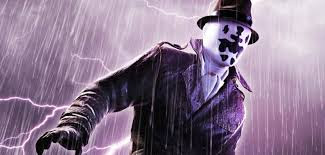
Both the film and graphic novel begin with the murder of Edward Blake, who is discovered by main protagonist Rorschach to be The Comedian. He was a member of a group of superheroes called the Minutemen in 1940 who went on to work for the US govt. The Comedian’s death is symbolised by the iconic image of a yellow smiley face badge with a splatter of blood on it. This image recurs throughout the comics and the movie. Rorschach is a ruthless character who sees the world as one in need of justice, and in his case, that justice is sometimes brutal. Taking his name from the psychological ink blot test, he wears a white mask with black liquid between the layers of fabric, which makes for a constantly changing Rorschach test. As we read (or watch) on, he believes this to be his true face and is not simply posing as Rorschach, he IS Rorschach. He might have been born Walter Kovacs, but one horrible encounter during a kidnapping incident changed him into Rorschach forever. His mask is the only face he feels he change show the world, seeing his mask-less face as his disguise.

Rorschach narrates part of the story, with his narrations coming from his journal. This gives us more insight into his character than any other, and despite his violent tendencies and extreme viewpoints, you find yourself sympathising with him and his plight. Jackie Earle Haley's performance as Rorschach in the movie is one of its biggest strengths. Among the numerous differences between the film and the graphic novels is one of my favourite changes, and it's only a small thing, but it gives Rorschach an awesome movie moment. 

When Rorschach is sent to prison, there is a scene where he's confronted by another prisoner, who threatens to shiv him in the canteen. Responding quickly, and without fear, Rorschach hits him upside the head with a tray and breaks the glass protector sheet between the queue and the kitchen servery. He proceeds to grab a boiling pot of oil and pours it over the hapless prisoner. As he is being restrained by prison guards, he yells out to the all of the onlookers:

"None of you seem to understand. I'm not locked in here with you, you're locked in here with me!!"

This whole incident is acted out in the movie, and Haley is brilliant in it. The graphic novel gives a second hand account of it via Malcolm Long, Rorschach's psychiatrist in prison. It has so much more menace and vitriol seeing the scene happen in person, rather than the line being relayed from another character. Nice work, Zac!

Of course, the crowning glory of the movie adaptation has to be the opening credits. Taking place straight after the murder of Blake, the titles are shown over a montage of scenes that depict the 1985 that this movie is set in, highlighting some events that have lead to it. A few of these scenes are only vaguely alluded to in the graphic novel, and to have them implicitly re-created in these little vignettes shows how much Snyder and his team mined from the source material. For instance, a superhero from the forties, Silhouette is shown kissing a nurse on VJ-Day in Times Square, referencing the famous photo of a sailor kissing a nurse on the same day in our timeline. It is hinted that the sailor is walking behind Silhouette, and so misses out on the kiss and the photo. This reveals that is superhero is a lesbian, and that things have become quite different, but the media still wields a lot of control. Another later scene in the titles show the nurse and Silhouette have been murdered in a bedroom, with a newspaper showing their famous kiss next to the bed. 

The existence of Silhouette is referenced more in the graphic novel, but if you hadn't read it, you wouldn't even know her name. The movie shows her death which is only referenced to in an interview with Silk Spectre, who laments the way she was turfed out of the Minutemen...the first group of superheroes who banded together in 1940. She explained that one reason she was ousted was due to her sexuality, even though there were other members who were gay. We find out in the 2017 HBO TV series Watchmen, that this may have meant Captain Metropolis and Hooded Justice. 

This is just one example of the movie fleshing out a small detail of the graphic novel. Getting back to that opening credits sequence, each vignette is presented like a photograph (or being itself photographed) except for minor movement, or slow motion. It's underscored by Bob Dylan's immortal The Times They Are A-Changin', and it fits perfectly as the years get closer to 1985. We learn that The Comedian was involved in the death of JFK, who had been at a media conference with Dr Manhattan in another scene, and that members of the Minutemen have either been killed, committed to a mental asyulm or retired. While the new group of superheroes consisting of Dr Manhattan, The Comedian, Silk Spectre II (the original's daughter), Ozymandias, Nite Owl II (protege of the original Nite Owl) and Rorschach is thought of as many as the Watchmen, they are never named as such in the novel. In fact, the famous quote 'Who watches the Watchmen?' is never shown in full in the comic either; it's always obscured. The quote itself is from Roman poet Juvenal who asked 'Quis custodiet ipsos custodes?' in reference to the guards posted to ensure the fidelity of his wife. 

As I've mentioned before, some of the casting is absolutely spot-on. Haley as Rorschach, Patrick Wilson as Nite Owl, Jeffrey Dean Morgan as The Comedian and Billy Crudup as Dr Manhattan are all terrific. I think Carla Gugino was a little miscast as Silk Spectre, and didn't really work in the older guise or as the younger character. She had great potential, but it didn't land for me. Same with Malin Akerman as her daughter Silk Spectre II (Laurie). Something was a bit off. She didn't have the spark and spit of the comic book character. Matthew Goode's casting as Adrian Veidt was another mistake, I feel. Again, he just didn't embody the character right for me, although he gave it a damn good go. The actor portraying Richard Nixon was pretty unconvincing as well, I felt.

The biggest difference between the graphic novel and the movie that I absolutely hated was Veidt blaming the destruction to the human race at the conclusion of the story on Dr Manhattan. In the comic, a giant squid has been created by artists, scientists and other experts by Veidt, with the masterplan being that it appears in New York City, as if from another dimension, dead but affecting the deaths of over three million people. The movie has several locations all over the world that appear to have been random targets of Dr Manhattan's deadly powers, but they have been instigated by Veidt with the express purpose of uniting the world against a common enemy, and avoiding World War III between the USA and Russia. 


The death of The Comedian at the start of the story sets Rorschach on an investigation that leads him to think that someone is trying to kill the old superheroes. Other events include Dr Manhattan seeking refuge on the planet Mars after falsely believing that he has given former co-workers and friends cancer, and an attempt of Veidt's life. Rorschach is sent to prison after being framed as the killer of Moloch, an old enemy of the Minutemen/Crimebusters who had since reformed and lived the life of a civilian. It turns out that Veidt was behind all of it, hiring his own hitman before killing his would-be assassian under the subterfuge of trying to pull a cyanide pill out of his mouth; when he actually crammed it in himself. 

Veidt's motive is the same in the graphic novel, but the blame is put on an alien entity that has seemingly appeared from another dimension, and poses a possible threat of alien invasion. This threat was meant to unite the world, which we are told it does in the comic, and the later TV series. Apparently this element of the plot was eliminated from Snyder's adaptation because he felt he would need at least 15 minutes to explain it. Time he felt would be better spent on developing the characters. Yeah, maybe. Don't like the change. 

Again, in both scenarios, Rorschach doesn't agree to keep the real source of the destruction a secret, and is bent on getting the news of Veidt's scheme to the people: "Never compromise. Not even in the face of Armageddon." In both the film and the comic, he is killed by Dr Manhattan who believes that the world will be better served if the human race never learns the truth. The big difference in Rorschach's death scene is that the movie shows Nite Owl watching and yelling out a nice big "Noooooooooooooooooooo!" as Rorschach's body is torn apart by his blue executioner. Unnecessary change, I felt, but I guess it adds to the emotion of the moment. I don't like the way Rorschach's character dies (or that he dies at all, really), but I see it like a suicide. Rorschach must know that Dr Manhattan will kill him, and the doc must realise there is only one way to stop Rorschach from spreading the news. 

It gives you more sympathy for Dr Manhattan's actions in the movie, because he realises that he is going to have to take the blame for Veidt's massacres. The good it will do for the planet outweighs the truth, and in killing Rorschach he seals his own fate. I don't like that Rorschach dies, and he's not exactly a model citizen, but it feels like his character drives the story. So, I guess it's kind of fitting that once he dies, the story nearly is as well. 

Both the movie and the comic hint that the journal Rorschach mails to the New Frontiersman paper (unnamed in the movie, I think) will see the truth come out anyway, which makes it all a bit baffling. But that's the fun of it. There's a few ways the future could pan out, but its up to the individual reader or viewer.

In conclusion, I think the graphic novel is the best way to enjoy Watchmen, but the Ultimate Cut of the movie is probably the closest we'll ever get.

*        *        *        *

After reading the comic, then watching the movie, then re-reading the comic, I watched the HBO TV series. And although I found it quite interesting, and certainly compelling in places, when it was all over I was like "Um, okay." I liked the premise, in that it is set in 2019 after the events of the comic in 1985. A giant squid killed three million people in NYC, the same as the comic. 

In this alternate world, members of the police wear masks to protect their identity. This is due to a massacre of police officers, dubbed 'White Night' that occurred years before, due to the ease of finding their personal details. This was carried out by a group called the Seventh Kavalry, who for some reason wear Rorschach masks. This is never really explained, but I'm guessing it's to show a strange camaraderie to him, embracing his more right-wing qualities and painting him falsely as modern Klansman. I didn't like that idea, but the device of police having to be masked was interesting. It further blurred the line between masked vigilante and law enforcer.

I also liked that the character of Laurie Jupiter (Silk Spectre II) had becomes an FBI agent going by the name of Laurie Blake. She learnt that The Comedian was her father after his death, and knew that he had attempted to rape her mother. In spite of this horrible act, it seems that both The Comedian and Silk Spectre engaged in consensual relations, with Laurie being born from that encounter. After hating Blake for many years after learning of the sexual assault, she is devastated to learn that he is actually her father. That her character goes by Laurie Blake in 2019 shows that she must have made peace with that fact somehow. She is wonderfully played by Jean Smart, who is pitch perfect. Someone with the same energy and delivery should have been considered for the movie.

Overall, I thought the casting was excellent, and Regina King carries the show with her performance bearing its weight with ease. Her Angela Abar is similar to Rorschach in Watchmen, as she drives the story, and most of the action is seen from her point of view, baring the Veidt storyline on Europa. Tim Blake Nelson is wonderful as masked police officer called Looking Glass, as his head covering is fully reflective. Don Johnson is great in a small role as the chief of police before being assassinated, casting doubt on his true motives and on whether he was a member of the Seventh Kavalry himself, in spite of pursuing them. Jeremy Irons is an interesting choice as Veidt (who spends most of the series imprisoned on Europa, which is a moon of Jupiter). I felt at times it worked, then at other times his character seemed unnecessarily cruel. Indeed his character in the comic was quite narcissistic, but there was a gentleness to him; until he needed to not be gentle. Again, a British actor used to portray Veidt which I find bizarre, but maybe that was to add an air of pomposity to him? 

Yahya Abdul-Matten II plays Angela's spouse Cal, and is very good. Particularly when it is revealed that he is not who he seems. I felt the actor who played a character called Will Reeves, Jovan Adepo, was excellent as well. It was a thrill to see the older character Reeves played by Louis Gossett, Jr too. Their character survived the Tulsa 'Black Wall Street' massacre in 1921 and is eventually revealed to not only be Hooded Justice, the first masked vigilante, but also Angela's grandfather.

There are numerous references to the original graphic novel, which does reward fans, but also enhances the world they are living in. Some nice plot points include Veidt orchestrating random showers of smaller alien squid to perpetuate the idea that invasion is still possible. Robert Redford has indeed become president, as hinted at the end of the comic, but we don't get see him unfortunately. A few scenes are set in Vietnam (now a state of the USA), and Dr Manhattan is almost worshiped as a deity, or derided as a devil, for his actions in ending the war in the sixties.

It won a heap of Emmy awards, with Regina and Yahya receiving the top gong in their categories and apparently had the highest number of nominations for a TV series ever. Among its swag was Outstanding Directing, Writing and TV Movie/Limited Series. Some categories saw multiple nominations, with Outstanding Supporting Actor getting nods for Louis, Yahya and Jovan. Trent Reznor and Atticus Ross also garnered awards and praise for the music, which is also very good. 

But yeah, by the end of it, I felt a little underwhelmed. I think the destination wasn't as good as the journey, which could be said of the original Watchmen graphic novel as well, I guess.